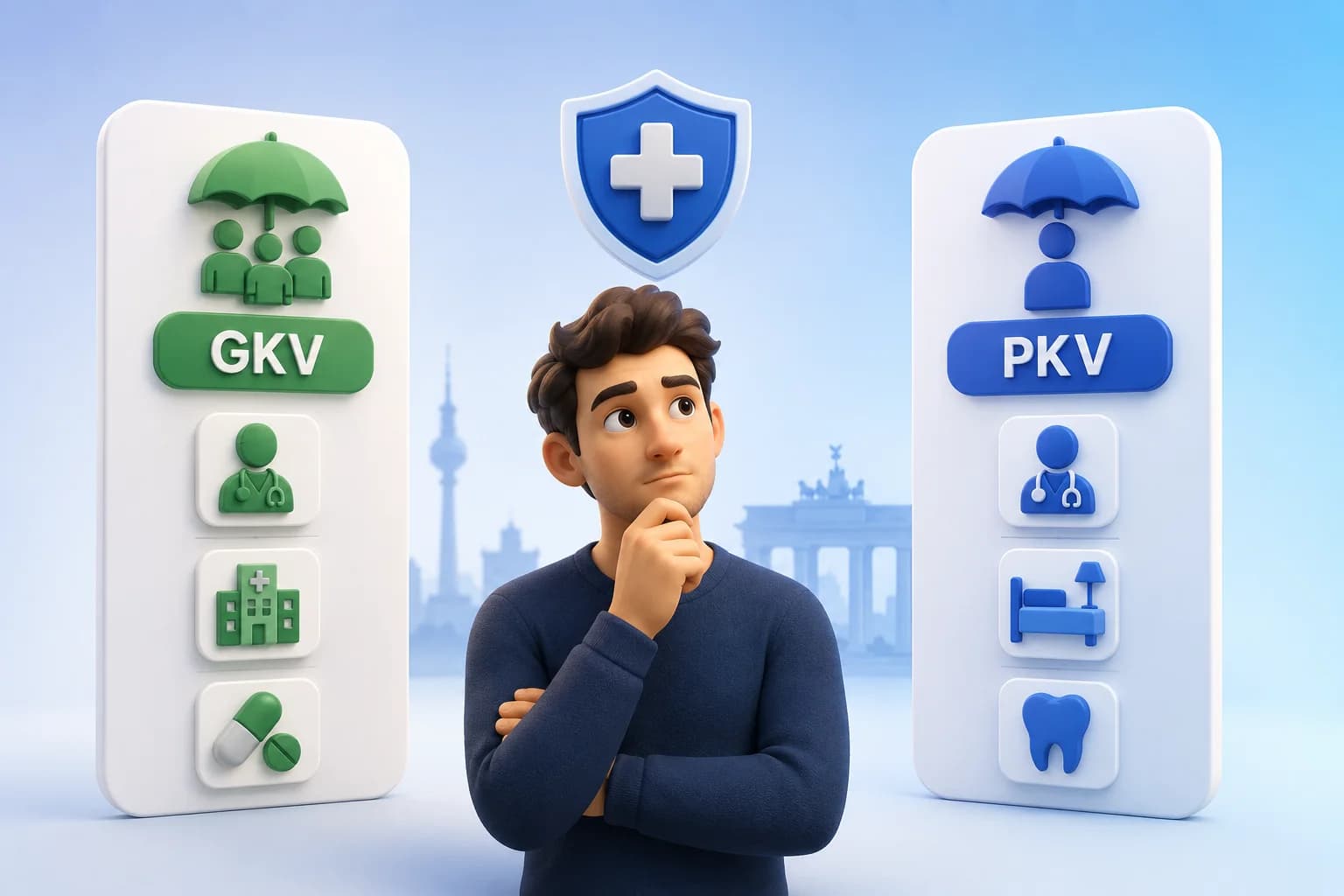
Germany operates a dual-track healthcare system. Every resident is legally required to maintain valid health insurance coverage. Navigating this system involves understanding the division between public statutory health insurance (Gesetzliche Krankenversicherung or GKV) and private health insurance (Private Krankenversicherung or PKV), as well as supplementary coverages that protect your personal assets.
The Dual-Track System: An Overview
The German healthcare architecture divides coverage options based primarily on income thresholds, employment status, and career type.
Key Regulatory Thresholds
- Jahresarbeitsentgeltgrenze (JAEG): This is the compulsory insurance limit. If your gross annual salary is below this government-set threshold, you must enroll in the public system (GKV). If your salary exceeds this threshold, you can choose between staying in the GKV as a voluntary member or switching to the private system (PKV).
- Beitragsbemessungsgrenze: This is the income cap for contribution calculations. For income earned above this limit, no additional healthcare contributions are assessed in the public system.
Public Health Insurance (GKV)
The public system operates on a solidarity principle. Contributions are based entirely on your ability to pay (income) rather than your personal health risk, age, or pre-existing conditions.
How GKV Contributions Are Calculated
Public insurance premiums are calculated as a percentage of your gross salary, up to the Beitragsbemessungsgrenze.
- Base Rate: The standard base rate is set at 14.6% of your gross salary.
- Supplementary Contribution (Zusatzbeitrag): Each individual public insurance fund (Krankenkasse) charges an additional percentage (typically ranging from 0.9% to 2.5% or more depending on the provider's financial reserves).
- Employer Split: For salaried employees, the total premium (base rate + supplementary contribution) is split equally (50/50) between the employee and the employer. Your share is deducted directly from your payslip.
- Long-Term Care Insurance (Pflegeversicherung): This is an obligatory add-on to your health insurance. It is also split between employer and employee, with slight variations depending on whether you have children.
Key Characteristics of GKV
- Family Insurance (Familienversicherung): Non-working spouses and children can often be co-insured under your policy at no additional cost, subject to certain income limits.
- Direct Billing: When visiting a doctor, you present your electronic health card (Gesundheitskarte). The medical provider bills the insurance company directly. You rarely see an invoice for standard care.
- Standardized Benefits: Approximately 95% of the benefits across different public health insurance providers are identical and mandated by law. Differences lie in optional travel insurance, professional dental cleaning subsidies, and digital administrative tools.