
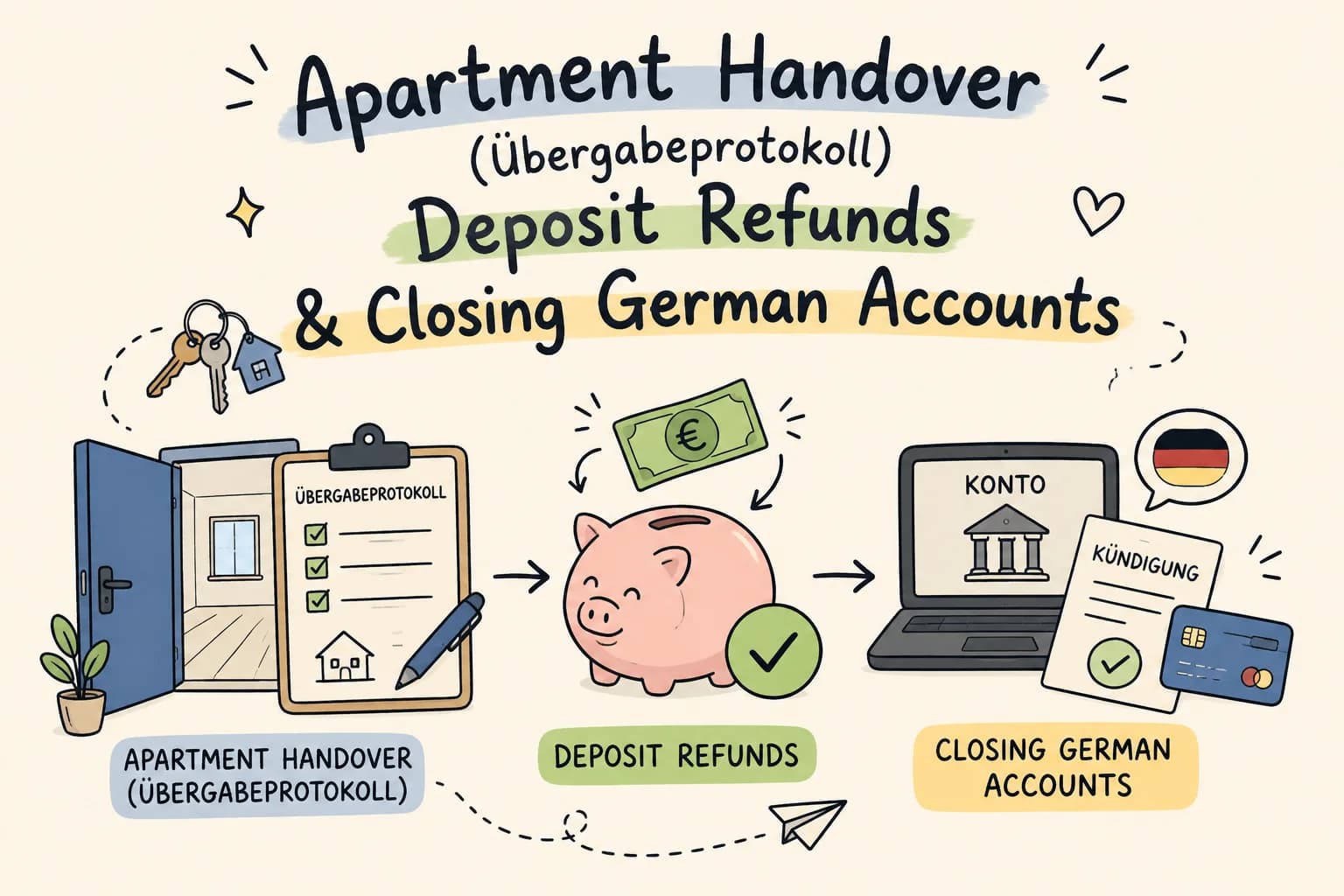
Apartment Handover (Übergabeprotokoll), Deposit Refunds & Closing German Accounts

·
8 min read
·0

Managing lease terminations, completing the formal apartment inspection protocol (Übergabeprotokoll), securing security deposit returns, and closing bank accounts.

Apartment Handover (Übergabeprotokoll), Deposit Refunds & Closing German Accounts

Relocating from Germany requires navigating structured administrative and legal processes. This guide outlines the steps required to terminate a lease, complete the formal apartment handover (Übergabeprotokoll), secure the return of the security deposit (Mietkaution), and close bank accounts and utility contracts.

Disclaimer: This guide is for informational purposes and does not constitute legal or financial advice. German rental and banking regulations can vary by state, municipality, and individual contract terms.


1. Terminating the Rental Agreement

To terminate a residential lease (Mietvertrag) in Germany, specific statutory rules must be followed to ensure the termination is legally binding.

The Written Form Requirement

Under Section 568 of the German Civil Code (Bürgerliches Gesetzbuch or BGB), a lease termination must be submitted in written form (Schriftform).

  • Signatures: The document must contain the physical, handwritten signatures ("wet signatures") of all tenants listed on the rental contract.
  • Exclusions: Digital signatures, scanned copies, emails, PDFs, faxes, or SMS messages are generally not legally valid for lease terminations under German law.
  • Delivery: The letter must be delivered physically. It is standard practice to send this via registered mail with advice of receipt (Einschreiben Einwurf or Einschreiben Übergabe) or to deliver it by hand with a signed receipt from the landlord to prove the exact date of delivery.

Notice Periods (Kündigungsfrist)

The statutory notice period for tenants is typically three months.

  • The termination letter must reach the landlord no later than the third working day of a calendar month for that month to count toward the three-month period. Saturdays are generally counted as working days in this context.
  • Example: To terminate a lease by the end of August, the landlord must receive the signed termination letter by the third working day of June.
  • Some contracts may contain a minimum rental period (Mindestmietdauer) during which termination is excluded, or specific individual agreements regarding shorter or longer notice periods.

2. Cosmetic Repairs and Preparing the Property

Before the handover, the apartment must be prepared according to the terms of the lease and prevailing case law.

Swept Clean (Besenrein) vs. Renovated

The contract determines the state in which the apartment must be returned:

  • Besenrein (Swept Clean): The tenant must vacuum or sweep the floors, clean major appliances, and remove all personal belongings and trash.
  • Schönheitsreparaturen (Cosmetic Repairs): Many older German lease templates contain clauses requiring the tenant to paint the walls or perform decorative repairs upon moving out. However, the German Federal Court of Justice (Bundesgerichtshof or BGH) has ruled many rigid painting schedules and "renovation-upon-exit" clauses invalid. Generally:
    • If the clause is legally invalid, the tenant may only need to return the apartment "swept clean."
    • If walls were painted in unusual, bright colors (e.g., red or dark blue), courts generally require them to be painted back to a neutral, easily rentable color (such as white or light beige), regardless of the clause's validity.
    • Any structural modifications or tenant-installed fixtures (e.g., kitchen units, light fixtures, custom shelves) must be removed, and the original state restored, unless the landlord explicitly agrees otherwise in writing.

3. The Apartment Handover (Übergabeprotokoll)

The handover protocol is a binding document signed by both the tenant and the landlord (or property manager/Hausverwaltung) at the end of the tenancy. It records the exact physical condition of the property.

Why the Protocol is Vital

Once both parties sign the Übergabeprotokoll, the landlord generally cannot claim compensation for damages that were not documented in the protocol, unless they are hidden defects that could not have been discovered during a standard inspection. It is the primary legal shield to secure the return of the deposit.

Key Elements to Document

  1. Meter Readings: Record the exact numbers for electricity, gas, heating, and water meters. Take photos of these meters with a time stamp.
  2. State of Every Room: Document any scratches on flooring, wall marks, tile chips, or appliance conditions.
  3. Keys: List every single key handed over (building entrance, apartment, mailbox, cellar, garage). Losing a system key can result in expensive lock replacement charges.
  4. Pending Repairs: Note which party is responsible for any agreed-upon fixes and the timeline for completion.
Handover Step Responsible Party Action Required
Pre-inspection (Vorabnahme) Landlord & Tenant Conducted 2–4 weeks prior to move-out to identify necessary repairs or painting.
Deep Cleaning Tenant Ensure the apartment is besenrein and any agreed cosmetic repairs are finished.
Final Inspection Landlord & Tenant Walk through every room together, filling out the Übergabeprotokoll.
Signing & Copying Both Parties Both sign the protocol. The tenant must receive a physical copy or a signed digital scan immediately.

4. The Security Deposit Refund (Mietkaution)

Under German law, the security deposit (up to a maximum of three months' cold rent) is held in a trust account to cover potential unpaid rent, utility arrears, or property damage.

Timelines for Refund

There is no statutory requirement in Germany for an immediate refund of the deposit upon move-out.

  • The 6-Month Window: Landlords are generally granted a reasonable period—often up to six months—to assess the property for damages and outstanding claims.
  • Utility Reconciliation (Nebenkostenabrechnung): Landlords are legally permitted to retain a proportional part of the deposit beyond six months if they anticipate an additional payment will be due on the next annual utility bill. This utility bill is often calculated on a calendar-year basis and must be provided to the tenant within 12 months of the end of the billing period.

Strategies for Expats

If you are leaving Germany permanently, recovering a deposit after six to twelve months can be logistically challenging.

  • Bank Account Continuity: Keep a German or SEPA-compliant bank account open to receive the refund (see Section 5).
  • Provide a Forwarding Address: Always provide your landlord with a written forwarding address outside Germany, as well as an active email address.
  • Partial Release: Request that the landlord release the undisputed portion of the deposit (e.g., 80%) within the first few weeks after a successful handover, retaining only a small, estimated portion for the final utility reconciliation.

5. Closing German Bank Accounts and Contracts

To avoid unexpected fees, debt collection (Inkasso), or negative credit ratings (SCHUFA), all recurring contracts and bank accounts must be terminated properly.

Bank Accounts (Girokonto)

While it may be tempting to close your German bank account immediately upon departure, doing so can complicate your deposit refund and final utility settlements.

  • Timing: Consider keeping your account active for at least 3 to 6 months after moving out to handle any outstanding utility debits or to receive your deposit.
  • Closure Process: Most traditional German banks require a signed written form or an online banking request to close an account. Check if your bank charges maintenance fees while the account remains open.
  • Address Update: Update your bank records with your new international address before you depart, so that any final statements or tax tax certificates are sent to the correct location.

Contract Cancellations & Special Right of Termination (Sonderkündigungsrecht)

In Germany, contracts (internet, gym memberships, electricity, mobile phones) often renew automatically for 12 or 24 months. However, moving abroad usually triggers a special right of termination under German consumer protection standards.

  • Required Proof: To exercise a Sonderkündigungsrecht, providers almost universally require a copy of your official deregistration certificate from the local citizens' office (Abmeldebestätigung), along with proof of your new address abroad (e.g., an employment contract, rental lease, or utility bill in the new country).
  • Notice Period: For telecommunication contracts (internet and phone), the notice period under the Telecommunications Act (TKG) is typically one month from the date the provider receives the cancellation and the proof of deregistration.
  • Broadcasting Fee (Rundfunkbeitrag): You must actively deregister from the mandatory TV/radio contribution fee. This can be completed online on the official portal (rundfunkbeitrag.de) by uploading your Abmeldebestätigung. They do not cancel this automatically when you leave.

6. Checklist: Leaving Germany

Use this practical timeline to organize your departure process:

Timeline Action Item Key Consideration
3 Months Before Send signed lease termination to landlord. Must be physical, signed by all tenants, and delivered by the 3rd working day.
2 Months Before Request pre-inspection (Vorabnahme). Identify what repairs, paint, or cleaning are expected.
1 Month Before Cancel utilities, internet, and insurance. Request early termination using your upcoming Abmeldebestätigung.
2 Weeks Before Register your departure (Abmeldung) at the city registry. Can typically be done up to 7 days before or 14 days after moving.
Handover Day Complete Übergabeprotokoll & return keys. Take timestamped photos of all rooms and meters.
Post-Departure Monitor bank account & deregister TV license. Keep the account funded for final utility debits until the deposit is returned.

Comments

0/2000

STAY CONNECTED WITH THE EXPAT COMMUNITY

Subscribe to get expat tips, local insights, and connect with professionals around the world.