Decoding Your German Rental Contract (Mietvertrag): A Clause-by-Clause Review

That exhilarating, slightly surreal moment has finally arrived. After countless viewings, dozens of applications, and navigating the unique gauntlet that is the German housing market, you’ve heard the magic words: "Sie haben die Wohnung bekommen!" (You got the apartment!). The relief is immense. But just as you’re about to celebrate, a new final boss appears: the Mietvertrag, your German rental contract.
Staring at this dense, multi-page document filled with formidable-sounding German words can feel more intimidating than the apartment hunt itself. But don't panic. This contract is your most important document as a tenant, outlining every right and responsibility you have. Signing it with confidence is the first step to truly making your new place a home.
As a fellow expat who has navigated this bureaucratic maze, I'm here to walk you through it, clause by clause. Let's decode your Mietvertrag together, so you can sign on the dotted line with clarity and peace of mind.
The Opening Act: Parties, Property, and Period
The first section of your contract sets the scene. It seems straightforward, but getting the details right here is crucial.
1. Die Vertragsparteien (The Contracting Parties) This part identifies the Vermieter (landlord) and the Mieter (tenant).
- Pro-Tip: Make sure every adult who will be living in the apartment is listed as a Mieter. This makes everyone jointly responsible but also gives them full tenant rights. If you're moving in with a partner, you both want your names on that contract. If a name is missing, that person is technically a sub-tenant with fewer protections.
2. Die Mietsache (The Rented Property) This clause defines exactly what you are renting. It will include the full address, the floor, and the apartment number. But look closer for these key details:
- Wohnfläche (Living Space): The size of the apartment in square meters (Quadratmeter, m²). This figure is often used to calculate your utility costs, so it should be accurate. If you later suspect the apartment is more than 10% smaller than stated, you may be entitled to a rent reduction.
- Zusätzliche Räume (Additional Rooms): Does the rental include a cellar space (Kellerabteil), an attic space (Dachboden), a parking spot (Stellplatz), or a garage? Make sure everything you were promised during the viewing is listed here.
3. Die Mietzeit (The Rental Period) This is a critical section that defines the length of your tenancy. You’ll typically find one of two options:
- Unbefristeter Mietvertrag (Unlimited Contract): This is the standard and most desirable type of contract in Germany. It has no end date. You can stay as long as you wish and can terminate the contract by giving the legally required notice (we'll cover that later).
- Befristeter Mietvertrag (Fixed-Term Contract): This contract has a specific end date. Be very cautious with these. German law is strongly pro-tenant, and a landlord can only legally issue a fixed-term contract for specific, valid reasons which must be stated in the contract. The most common reason is Eigenbedarf (personal use), meaning the landlord or their close family intends to move in after the term ends. If no valid reason is given, the clause may be invalid, and the contract could revert to an unlimited one.

The Money Matters: Deconstructing Your Rent
This is the part everyone cares about most. In Germany, your monthly payment is more than just "rent." It's broken down into several components.
Kaltmiete (Cold Rent): This is the base rent for the property itself, excluding all other costs. This is the number used to calculate your security deposit.
Nebenkosten (Ancillary Costs): Also called Betriebskosten, these are the shared operational costs for the building, which the landlord passes on to the tenants. You pay a monthly estimate, or Vorauszahlung. Common Nebenkosten include:
- Water and sewage
- Trash and recycling collection
- Property tax (Grundsteuer)
- Building insurance
- Street and building cleaning
- Gardening services
- Chimney sweeping
- Elevator maintenance
- Hausmeister (caretaker) services
Warmmiete (Warm Rent): This is your total monthly payment to the landlord. It is the sum of the Kaltmiete and the Nebenkosten pre-payment.
What's NOT included? Your Warmmiete almost never includes your personal electricity (Strom), internet, or the mandatory broadcasting fee (Rundfunkbeitrag or formerly GEZ). You will need to sign separate contracts with providers for these services yourself.
The Nebenkostenabrechnung (Annual Utility Statement) Once a year, your landlord must provide you with a detailed breakdown of the actual utility costs versus what you prepaid. If you used less than you paid for, you get a refund (Guthaben). If you used more, you'll receive a bill for the difference (Nachzahlung), and your monthly pre-payments for the following year may be adjusted.
The Upfront Costs: Deposit and Potential Increases
Before you get the keys, you'll have to handle the security deposit. And down the line, your rent might go up. Here’s how it works legally.
Die Mietkaution (The Security Deposit) The Kaution is your landlord’s security against damages or unpaid rent.
- Legal Limit: By law (§ 551 BGB of the German Civil Code), the deposit cannot exceed three months' Kaltmiete. Be wary of any demand for more.
- Payment: You have the right to pay the deposit in three equal monthly installments, with the first payment due at the start of the rental period.
- How it's Held: This is critically important. Your landlord is legally required to keep your deposit in a separate, interest-bearing escrow account (Mietkautionskonto), completely separate from their personal or business assets. This protects your money if the landlord goes bankrupt. Ask for proof of this account.
Die Mieterhöhung (The Rent Increase) A landlord can't just raise your rent on a whim. Any increase must follow strict legal guidelines. The most common methods you'll see in a contract are:
- Staffelmiete (Graduated Rent): The contract specifies the exact dates and amounts of future rent increases. This provides predictability but removes any need for negotiation.
- Indexmiete (Indexed Rent): The rent is tied to Germany’s official Consumer Price Index. The rent can be increased (or theoretically, decreased) once per year in line with inflation.
- Increase to Local Average (Vergleichsmiete): For standard unlimited contracts, a landlord can raise the rent to the level of comparable apartments in the area, often proven by a city's official rent index (Mietspiegel). Even then, they cannot raise it by more than 20% (or 15% in some cities with tight housing markets) within a three-year period.
Key Clauses & Your Responsibilities: A Quick Guide
Here's a table breaking down some of the most important clauses you'll encounter.
| German Term | English Translation | What It Means for You |
|---|---|---|
| Kaltmiete | Cold Rent | Your base rent, excluding utilities. The basis for your deposit. |
| Nebenkosten | Ancillary Costs | Pre-payment for services like water, trash, building upkeep. |
| Warmmiete | Warm Rent | Kaltmiete + Nebenkosten. Your monthly payment to the landlord. |
| Kaution | Security Deposit | Max. 3x Kaltmiete. Must be held in a special account. |
| Schönheitsreparaturen | Cosmetic Repairs | Clause detailing your responsibilities for painting, etc. Check this carefully! |
| Hausordnung | House Rules | Legally binding rules about quiet hours, trash, and common areas. |
| Kündigungsfrist | Notice Period | Typically 3 months for tenants to terminate the contract in writing. |
| Übergabeprotokoll | Handover Protocol | A crucial document recording the flat's condition on move-in/move-out. |
The Fine Print: Repairs, Pets, and House Rules
This is where day-to-day life is governed. Pay close attention.
Schönheitsreparaturen (Cosmetic Repairs) This is one of the most disputed clauses in German rental contracts. It refers to minor decorative work like painting walls and ceilings, filling drill holes, and painting doors and windows from the inside.
- The Modern Rule: German courts have invalidated many old, rigid clauses. For example, a clause forcing you to renovate on a fixed schedule (e.g., "every 5 years") is usually void. Crucially, if you received the apartment in an un-renovated state (unrenoviert), you generally cannot be required to return it fully renovated. The clause must be fair and flexible. If it seems overly demanding, it may not be legally enforceable.
Kleinreparaturen (Minor Repairs) Most contracts include a clause making the tenant responsible for the cost of small repairs to items they use frequently. This could include a dripping tap, a broken toilet seat, or a faulty light switch. There are strict limits: the cost for a single repair is typically capped at around €100-€120, and the total annual cost to you is also capped (e.g., at 8% of the annual cold rent).
Tierhaltung (Keeping Pets) The rules on pets are nuanced. A blanket ban on all pets is legally void.
- Small Animals: Animals in cages, tanks, or terrariums (like hamsters, fish, or guinea pigs) are always permitted and do not require the landlord's consent.
- Cats and Dogs: For larger pets, you almost always need the landlord's permission. The landlord must have a valid reason for refusing (e.g., the building is unsuitable, or the animal is a genuine nuisance).
The Exit Plan: Termination and Handover
Hopefully, you'll be happy in your new home for a long time. But when it's time to move on, you need to know how to end the contract correctly.
Kündigung (Termination of Contract) For a standard, unlimited contract (unbefristeter Mietvertrag):
- Your Notice Period (Kündigungsfrist): As a tenant, your statutory notice period is always three months to the end of a calendar month. It doesn't matter if you've lived there for six months or six years. Your written termination notice must be received by your landlord no later than the third working day of the month for that month to count as the first of the three.
- Landlord's Notice Period: The notice period for landlords is much longer and increases the longer you have been a tenant, starting at three months and going up to nine months after eight years of tenancy. They also need a legally valid reason to terminate your contract, such as Eigenbedarf.
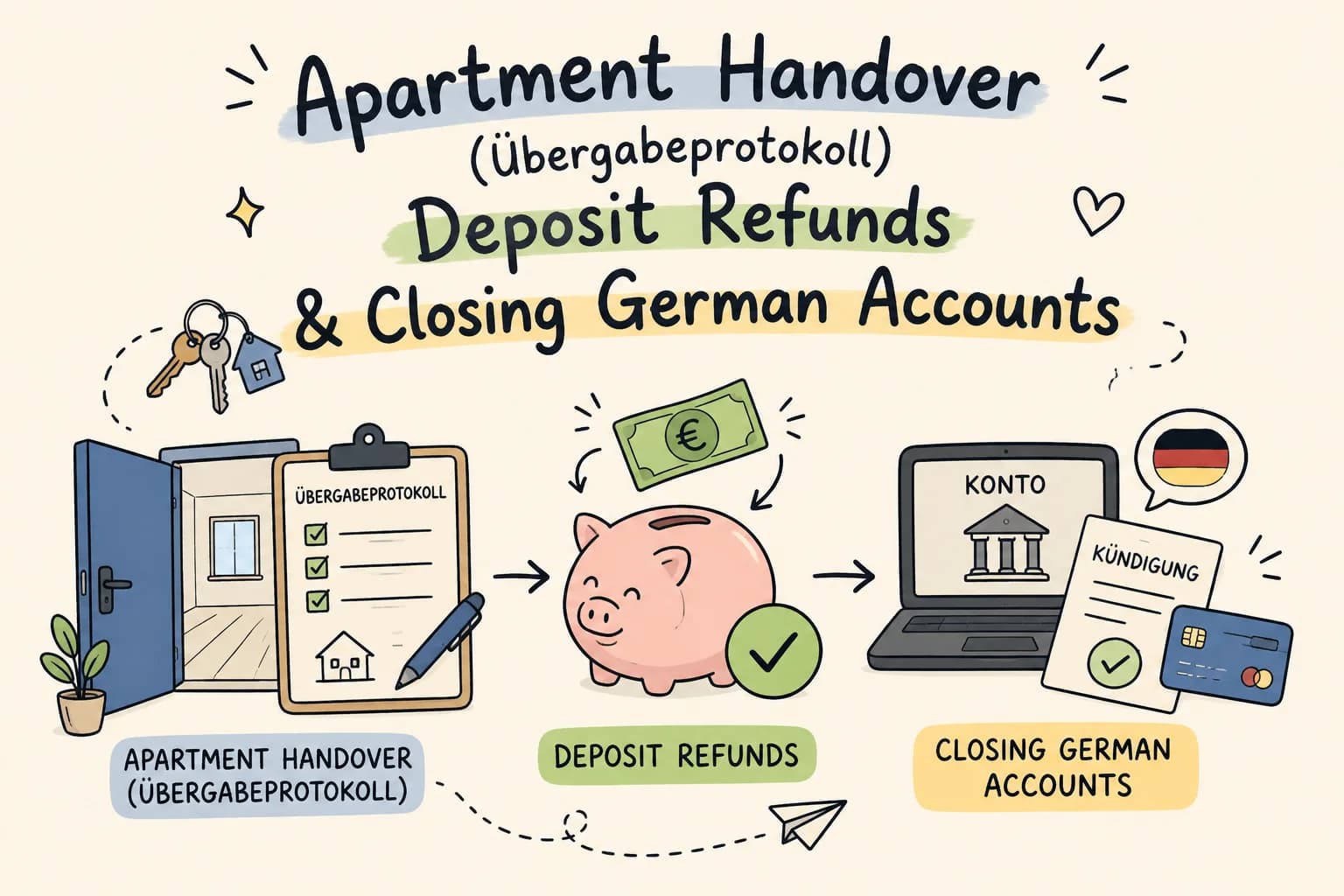
Das Wohnungsübergabeprotokoll (The Handover Protocol) This is arguably the most important document besides the contract itself. The Übergabeprotokoll is a written record of the apartment's condition when you move in and when you move out.
- At Move-In: Go through the apartment with your landlord or property manager and document every single flaw—scratches on the floor, cracks in the tile, stains on the wall. Take photos and videos. Record the meter readings for electricity, water, and gas. Both you and the landlord should sign it. This protocol is your proof of pre-existing conditions and protects your deposit.
- At Move-Out: A similar inspection will be done. The move-in protocol will be used as a reference to see if any new damage has occurred beyond normal wear and tear (normale Abnutzung).
Your Ultimate Expat Tip: Join the Mieterverein
If there is one piece of advice you take away from this article, let it be this: join your local Tenants' Association, the Mieterverein or Mieterschutzbund. For a relatively small annual fee (usually €70-€120), you get access to free legal advice from lawyers specializing in German tenancy law. They can review your Mietvertrag before you sign it, help you draft letters to your landlord, and represent you in disputes. It's the best "insurance" an expat renter in Germany can have.
Navigating a German rental contract is a rite of passage for every expat. By taking the time to understand these key clauses, you transform a daunting legal document into a clear agreement. You're not just renting a space; you're securing your rights and setting the foundation for a happy life in your new German home. Congratulations, and welcome home
Subscribe to Our Newsletter
Welcome to our newsletter hub, where we bring you the latest happenings, exclusive content, and behind-the-scenes insights.
*Your information will never be shared with third parties, and you can unsubscribe from our updates at any time.