Housing Rights in Germany: What Every Tenant Should Know

Navigating the German housing market can feel like a major victory. You’ve conquered the apartment viewings, charmed a potential landlord, and now you’re holding it: the Mietvertrag, a multi-page rental contract dense with official-sounding German. It’s a thrilling moment, but it can also be intimidating. What are you actually signing? What happens if your heating breaks in the middle of a freezing Berlin winter? Can your landlord just raise the rent out of the blue?
Take a deep breath. The good news is that Germany has some of the most robust, pro-tenant housing laws in the world. The system is designed to provide stability and protect you from arbitrary decisions. Understanding these rights isn’t just about avoiding problems; it’s about feeling secure and empowered in your new home. This guide will walk you through the essential housing rights every expat in Germany should know.
Your Bible: The Rental Contract (Mietvertrag)
Everything starts with your rental contract. Don't let the complex language scare you; understanding its key components is your first line of defense. Most contracts are standard, but it's crucial to know what to look for.
- Indefinite vs. Fixed-Term (unbefristet vs. befristet): An indefinite contract is the norm and is what you want. It means you can stay as long as you like, provided you follow the rules. A fixed-term contract is only legally valid if the landlord provides a specific reason for the time limit, such as planning to use the apartment themselves (Eigenbedarf) or undertaking major renovations after the term ends. Vague reasons are not legally binding.
- The Rent Breakdown: Your contract will split the rent into three key figures:
- Kaltmiete (Cold Rent): This is the base rent for the apartment itself.
- Nebenkosten (Additional Costs): These are prepayments for utilities and services like heating, water, trash collection, building maintenance, and property taxes. Electricity and internet are almost always separate and paid directly by you to a provider of your choice.
- Warmmiete (Warm Rent): This is the total of the Kaltmiete and Nebenkosten—the amount you transfer to your landlord each month.
Once a year, you’ll receive a Nebenkostenabrechnung, a detailed statement of the actual utility costs. If you paid more than you used, you get a refund. If you used more, you'll have to pay the difference. The landlord has up to 12 months after the accounting period ends to provide this statement.
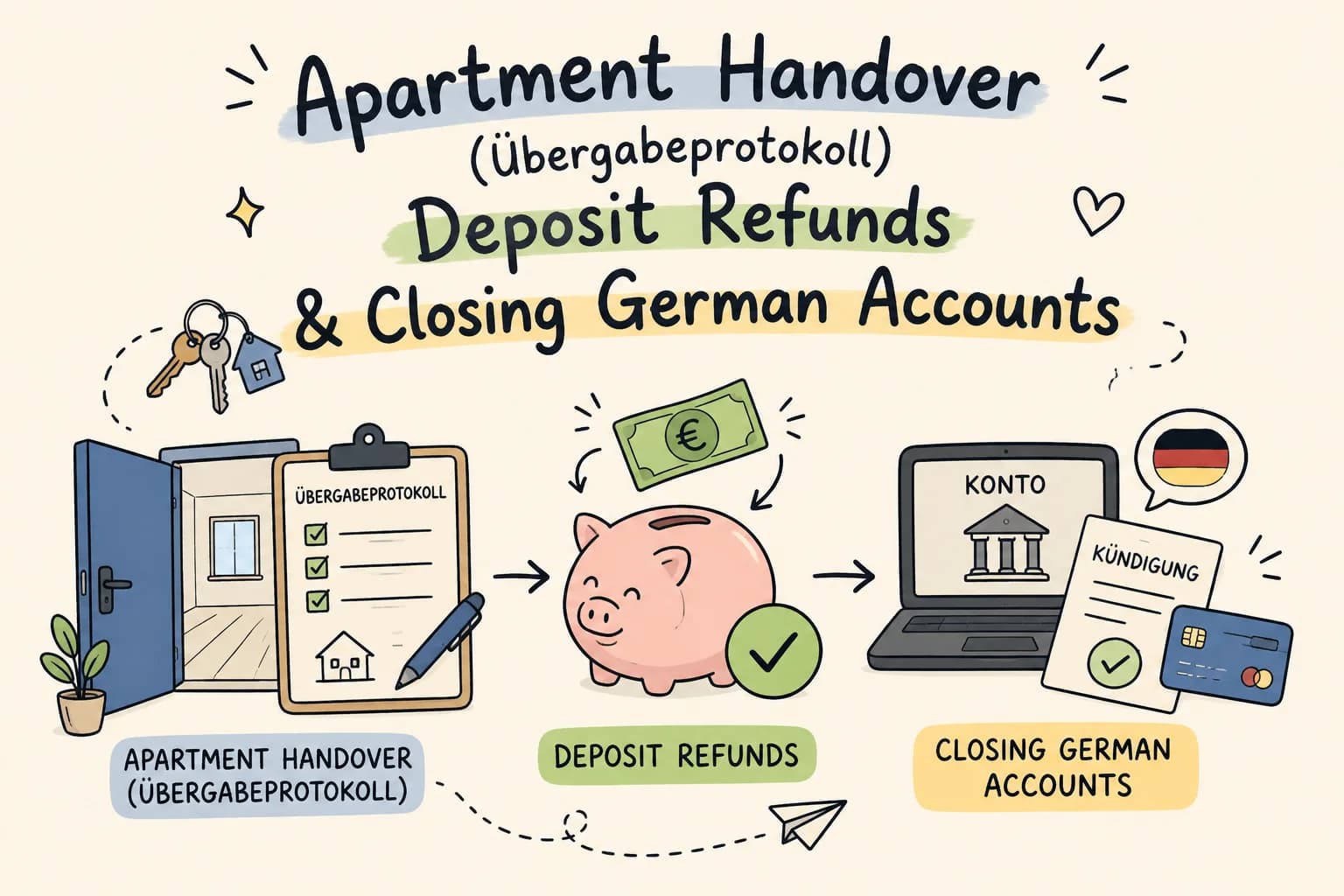
Pro Tip: Always, always complete a handover protocol (Übergabeprotokoll) when you move in. This document, signed by both you and the landlord, records the condition of the apartment and notes any existing defects (scratches on the floor, cracks in a tile). Take photos! This document is your proof against being charged for pre-existing damages when you move out.
The Security Deposit (Kaution): Your Protected Investment
Nearly every landlord will ask for a security deposit, known as the Kaution. German law is very specific about how this must be handled.
- The Legal Limit: A landlord cannot ask for more than three months' worth of Kaltmiete (cold rent). Anything more is illegal.
- Separate Account: Your landlord is legally required to keep your deposit in a separate, interest-bearing savings account, completely apart from their personal or business assets. This protects your money in case the landlord goes bankrupt.
- Interest is Yours: You are entitled to the interest earned on your deposit.
- Getting it Back: This is a common point of anxiety for expats. After you move out, the landlord has a "consideration period" to check for damages or wait for the final utility bills. While there's no strict legal deadline, 3 to 6 months is typical. If there are no outstanding claims, they must return the full deposit with interest. If they make deductions for damages, they must provide a detailed list of costs. Deductions cannot be made for normal "wear and tear" (normale Abnutzung), like minor scuffs on the wall.

Rent Increases (Mieterhöhung): No Nasty Surprises
Your landlord can't simply increase your rent on a whim. Rent hikes are strictly regulated by law, and they must fall into one of three categories.
-
Alignment with Local Market Rent (Vergleichsmiete) This is the most common type of increase. The landlord can raise the rent to match the average price for similar apartments in your area. This average is determined by a city's official rent index, the Mietspiegel.
- The Cap: The rent cannot be increased by more than 20% within a three-year period. In cities with tight housing markets like Munich, Berlin, and Hamburg, this cap is often lowered to 15% (Kappungsgrenze).
- Written Notice: You must receive a formal written request for the increase at least three months before it takes effect, and it must justify the new price by referencing the Mietspiegel or citing a few comparable apartments. You must consent to the increase; if you don't, the landlord would have to sue for approval.
-
After Modernization (Modernisierungsumlage) If the landlord makes significant improvements to the property—such as adding a balcony, installing an elevator, or improving energy efficiency—they can pass on some of the costs.
- The Limit: They can add up to 8% of the modernization costs to the annual rent.
- Maintenance vs. Modernization: Simple repairs and maintenance do not count. Replacing a broken heating system with a similar new one is maintenance; upgrading it to a much more energy-efficient model is modernization.
-
Pre-agreed Increases (Staffel- or Indexmiete) If your contract includes a Staffelmiete (graduated rent) or Indexmiete (indexed rent), the increases are automatic.
- Staffelmiete: The contract specifies the exact rent amount for future years. The rent must remain the same for at least 12 months between increases.
- Indexmiete: The rent is tied to Germany's official consumer price index. The landlord can increase it once per year in line with inflation.
- The Catch: If you have one of these clauses, the landlord cannot use any other reason (like the Mietspiegel) to raise your rent.
Furthermore, many major German cities have a "rent brake" (Mietpreisbremse). In these designated areas, the rent for a new rental contract cannot be more than 10% above the local Vergleichsmiete.
Repairs and Maintenance: Who Is Responsible?
In Germany, the landlord is fundamentally responsible for ensuring the apartment is in a safe and habitable condition.
| Issue | Landlord's Responsibility | Tenant's Responsibility (Potentially) |
|---|---|---|
| Heating & Hot Water | Must be functioning. Landlord must fix any failures promptly. | Reporting the issue immediately. |
| Plumbing & Leaks | Responsible for pipes, faucets, and fixtures. Must repair leaks. | Minor clogs caused by tenant. |
| Mold (Schimmel) | Generally the landlord's issue, especially if caused by structural problems (poor insulation, leaky pipes). | If caused by improper ventilation (e.g., not airing rooms daily). This can be a contentious issue. |
| Appliances (if included) | If the landlord provided the stove or fridge, they are responsible for its repair or replacement. | If you brought your own appliances, they are your responsibility. |
| Minor Repairs (Kleinreparaturen) | Major repairs are always the landlord's job. | A Kleinreparaturklausel in your contract can make you responsible for small fixes (e.g., a broken faucet handle or light switch). |
The Kleinreparaturklausel is only valid if it specifies a cost limit per repair (usually €75-€120) and an annual total cap (often around 8% of the annual Kaltmiete).
What to do if something breaks: Inform your landlord immediately, preferably in writing (email is fine). Set a reasonable deadline (Frist) for the repair. If the landlord fails to act on a serious issue (like no heating in winter), you have the right to reduce your rent (Mietminderung) for the duration of the problem. This must be done carefully, as reducing it by too much could lead to eviction. Always seek legal advice first.
Ending Your Tenancy (Kündigung)
How you (or your landlord) can end the contract is also strictly defined.
- For the Tenant: If you have an indefinite contract, the standard notice period is three months. Your notice of termination (Kündigungsschreiben) must be in writing, signed, and received by the landlord by the third working day of the month to count for that month. For example, to move out at the end of June, your notice must arrive by the third working day of April.
- For the Landlord: This is where German law is most protective. A landlord cannot terminate your indefinite contract without a legally valid reason. Simply wanting a new tenant is not enough. The most common reasons are:
- Eigenbedarf (Personal Use): The landlord needs the apartment for themselves or a close family member (parents, children, grandparents). They must provide a detailed explanation.
- Significant Breach of Contract: This includes being consistently late with rent, being in arrears for more than two months' rent, or using the property for illegal activities.
- Economic Hardship: The landlord can argue that keeping you as a tenant prevents them from making reasonable economic use of the property (e.g., they need to sell it vacant because they are bankrupt). This is very difficult to prove.
The landlord's notice period depends on how long you've lived there:
- Less than 5 years: 3 months
- 5 to 8 years: 6 months
- More than 8 years: 9 months
The Myth of Mandatory Renovation (Schönheitsreparaturen)
Many contracts, especially older ones, contain a clause requiring the tenant to perform cosmetic repairs (Schönheitsreparaturen), such as painting the walls, upon moving out. Be very careful here.
Over the years, German federal courts have invalidated many of these clauses. A clause is likely invalid if:
- It forces you to renovate on a rigid schedule (e.g., "kitchen every 3 years, living room every 5 years").
- It requires you to renovate even if the apartment was unrenovated when you moved in.
- It specifies the exact color you must use for painting.
If the clause is invalid, you are not obligated to do anything beyond leaving the apartment clean and returning it in the condition you received it, minus normal wear and tear.
Your Secret Weapon: The Tenant Association (Mieterverein)
If there's one piece of advice to take away, it's this: Join your local Mieterverein or Mieterschutzbund.
These are non-profit tenant associations that provide legal advice and support for a small annual fee (typically €70-€120). For this fee, you get access to lawyers who specialize in tenancy law. They can review your rental contract, help you write letters to your landlord, and advise you on any issue, from a rent increase to getting your deposit back. It is the single best investment you can make for peace of mind as a renter in Germany. You can find your local branch through the national Deutscher Mieterbund website.
Your Takeaway
Renting in Germany can feel complex, but the system is on your side. The law provides a strong safety net that prioritizes your right to a stable and secure home. By understanding the basics of your contract, knowing your rights regarding deposits and rent increases, and having the Mieterverein as a backup, you can navigate your tenancy with confidence. So, read your contract, document everything, and enjoy the security that comes with being an informed tenant in Germany.
Subscribe to Our Newsletter
Welcome to our newsletter hub, where we bring you the latest happenings, exclusive content, and behind-the-scenes insights.
*Your information will never be shared with third parties, and you can unsubscribe from our updates at any time.