Starting as a Freelancer (Freiberufler) in Germany: A Complete Guide

So, you’ve made the leap. You’re living in Germany, enjoying the Feierabendbier, and trying to figure out which bin the pizza box goes in. Now, another dream is calling: the freedom of freelancing. The idea of being your own boss, working from a cozy Berlin café, and shaping your own career path is incredibly appealing. But then you hear the whispers of the legendary German bureaucracy, the Beamtendeutsch (officialese), and a mountain of paperwork.
Let's be honest: it can be intimidating. But I’m here to tell you it’s absolutely doable. As an expat who has navigated this path, I want to give you the clear, step-by-step guide I wish I’d had. We’ll cut through the jargon and turn that mountain into a manageable series of hills.
First Things First: Are You a Freiberufler or a Gewerbetreibender?
This is the most critical question you need to answer before you do anything else, as it determines your entire registration process, your tax obligations, and even the type of business you can run. In Germany, "freelancer" isn't a catch-all term. The law makes a sharp distinction between two types of self-employment:
- Freiberufler (Liberal Profession): This category is for specific professional fields that are considered "liberal professions" (freie Berufe). These are generally academic, artistic, or "service of a higher kind" roles. Think doctors, lawyers, engineers, architects, journalists, translators, artists, and consultants. The official list is in § 18 of the Income Tax Act (Einkommensteuergesetz).
- Gewerbetreibender (Trade / Commercial Activity): This covers pretty much everyone else. If you are a commercial trader, a craftsman, you run a shop, an IT service that isn't purely consulting, or you resell goods, you fall into this category.
Why does this matter so much? The life of a Freiberufler is significantly simpler from a bureaucratic standpoint.
| Feature | Freiberufler (Liberal Profession) | Gewerbetreibender (Trader) |
|---|---|---|
| Registration | Register only with the Tax Office (Finanzamt). | Register with the Trade Office (Gewerbeamt) and the Tax Office (Finanzamt). |
| Main Tax | Income Tax (Einkommensteuer), VAT (Umsatzsteuer). | Income Tax, VAT, and Trade Tax (Gewerbesteuer). |
| Accounting | Simple cash-based accounting (Einnahmen-Überschuss-Rechnung) is usually sufficient. | May require more complex double-entry bookkeeping. |
| Memberships | No mandatory membership in the Chamber of Commerce (IHK). | Mandatory membership and fees for the Chamber of Commerce and Industry (IHK). |
The key takeaway? As a Freiberufler, you don't have to register a trade with the Gewerbeamt and, most importantly, you do not pay trade tax (Gewerbesteuer). This is a massive advantage. If you're unsure which category you fall into, your local Finanzamt has the final say. It’s often wise to consult with a tax advisor (Steuerberater) to get this right from the start.
The Visa: Your Ticket to Freelance Freedom (for Non-EU Citizens)
If you’re from the EU/EEA or Switzerland, congratulations! You can move to Germany and start your freelance journey without a special visa. You just need to register your address and then follow the tax registration steps below.
For everyone else, the residence permit for the purpose of freelance work (Aufenthaltserlaubnis zur Ausübung einer freiberuflichen Tätigkeit) is your golden ticket. You'll typically apply for this at the local Foreigners' Office (Ausländerbehörde) after arriving in Germany on a job seeker visa or another appropriate entry visa.

The requirements can vary slightly by city, but you should be prepared to present a robust application package. Here’s what you’ll almost certainly need:
- Valid Passport: Self-explanatory.
- Completed Application Form: The Antrag auf Erteilung eines Aufenthaltstitels.
- Biometric Photo: Must meet German passport photo standards.
- Proof of Health Insurance: It must be a German-compliant plan. We’ll cover this in more detail later.
- Proof of Address Registration (Anmeldebestätigung): Your official proof that you have a place to live.
- Business Plan: This needs to be convincing. It should detail your business concept, target market, and strategies.
- Financial Plan / Revenue Forecast: How will you make money? You need to show projected income and expenses for the next few years to prove your business is sustainable.
- Proof of Secured Livelihood (Finanzierungsplan): You must show you have enough money in the bank to support yourself while your business gets off the ground. There's no magic number, but having enough to cover at least 6-12 months of living expenses is a safe bet.
- Letters of Intent from Potential Clients (Absichtserklärungen): These are a game-changer. They are non-binding letters from future clients in Germany stating they intend to hire you for specific projects once you are registered. Two to three strong letters can significantly boost your application.
- Professional Permits/Licenses (if applicable): If your profession is regulated (like an engineer or architect), you'll need proof of your qualifications being recognized in Germany.
- CV and University Diplomas: To prove you have the skills for your chosen field.
Pro-Tip: The case worker at the Ausländerbehörde wants to see that your freelance activity will have a "positive economic or cultural impact" on Germany. Frame your application to highlight this.
The Registration Marathon: Step-by-Step
Once your visa is sorted (or if you don't need one), it's time to get registered. This is where you officially tell the German government, "I'm in business!"
Step 1: Register Your Address (Anmeldung)
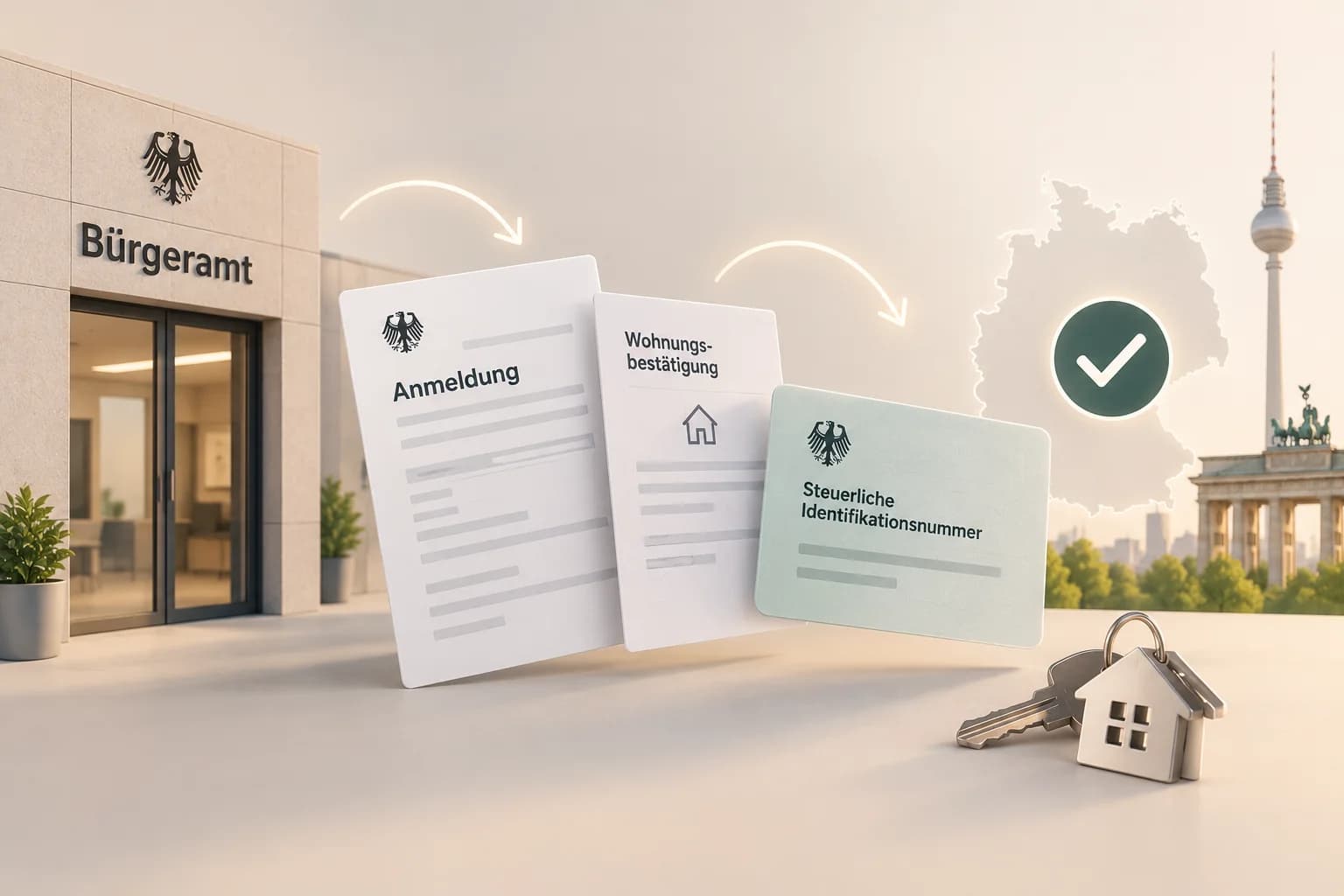
This is the first step for anyone moving to Germany, freelancer or not. You must register your address at the local citizens' office (Bürgeramt or Einwohnermeldeamt) within 14 days of moving in. You’ll need your passport and a form signed by your landlord (Wohnungsgeberbestätigung). Upon completion, you'll receive your registration certificate (Anmeldebestätigung) and, a few weeks later by mail, your Tax Identification Number (Steueridentifikationsnummer or IdNr). This is a permanent ID number for life—guard it carefully!
Step 2: Register with the Tax Office (Finanzamt)
This is the core of becoming a freelancer. You need to inform your local Finanzamt of your new freelance activity. You do this by filling out a form called the Fragebogen zur steuerlichen Erfassung (Questionnaire for Tax Registration).
Historically a paper form, this is now almost exclusively done online through the German government's tax portal, ELSTER. While the portal is mostly in German, it’s a necessary hurdle.
This form asks for everything: your personal details, your bank account information, your projected earnings for the first year, and crucially, whether you want to be treated as a small business owner (Kleinunternehmer).
Once the Finanzamt processes your form (which can take several weeks), they will issue you a Tax Number (Steuernummer). This is different from your Steuer-ID. The Steuernummer is what you will use on your invoices and for all your business tax filings.
The Money Talk: German Taxes for Freelancers
Understanding the tax system is non-negotiable. It’s not as scary as it looks, but you must be diligent.
Income Tax (Einkommensteuer)
As a freelancer, you pay progressive income tax on your profits (income minus business expenses). The tax rate increases with your income. There is a tax-free allowance (Grundfreibetrag), which for 2024 is €11,604 for single individuals. You only pay tax on earnings above this amount. You'll be required to make quarterly pre-payments based on your projected income, with a final tax return (Steuererklärung) filed the following year to settle the exact amount.
Value Added Tax (VAT) - Umsatzsteuer (USt)
VAT (often called Mehrwertsteuer or MwSt) is a tax on goods and services. The standard rate in Germany is 19%, with a reduced rate of 7% for certain goods like books and food.
If you are a regular freelancer, you must add 19% VAT to your invoices, collect it from your clients, and pay it to the Finanzamt through regular VAT returns (usually monthly or quarterly). The upside is that you can also reclaim the VAT you pay on your own business expenses (like a new laptop or software).
The Small Business Owner Rule (Kleinunternehmerregelung)
This is a lifesaver for many new freelancers. Under § 19 of the VAT Act, you can opt to be a Kleinunternehmer if:
- Your revenue in the previous calendar year was no more than €22,000.
- Your projected revenue in the current calendar year will be no more than €50,000.
If you choose this status, you do not charge VAT on your invoices and you do not have to file regular VAT returns. This massively simplifies your bookkeeping. The downside? You cannot reclaim VAT on your business purchases. For most freelancers starting out, the simplicity is well worth it. You indicate your choice on the Fragebogen zur steuerlichen Erfassung.
Mandatory Health Insurance: The German Way
Health insurance is not optional in Germany; it’s a legal requirement for every resident. As a freelancer, you have two main options:
- Public Health Insurance (Gesetzliche Krankenversicherung - GKV): You can join one of the public "sickness funds" like TK, AOK, or Barmer. As a freelancer, your monthly contribution is based on your income, typically around 14.6% plus a small additional contribution from the specific insurer. There is a minimum and maximum contribution amount. GKV covers pre-existing conditions and your non-working dependents (spouse, children) are often covered for free.
- Private Health Insurance (Private Krankenversicherung - PKV): You can opt for a private plan. Here, your monthly premium is based on your age, health status, and the level of coverage you choose—not your income. This can be cheaper than GKV if you are young, healthy, and have a high income. However, premiums can rise significantly with age, and every family member needs their own separate (and expensive) policy. Switching back from PKV to GKV is very difficult, so this decision should be made carefully.
Special Mention: The Künstlersozialkasse (KSK) If you are an artist, musician, writer, journalist, or publicist, you may be eligible to join the KSK. This is a unique German institution that acts as your "fictional employer." If accepted, the KSK pays half of your health, pension, and nursing care insurance contributions, just like a regular employer would. This can cut your social security costs in half and is an incredible benefit for creative professionals. The application process is detailed, but well worth the effort if you qualify.
Practical Tips for a Smooth Start
- Open a Separate Bank Account: Even if not legally required at first, open a separate business bank account. It makes tracking income and expenses infinitely easier and keeps the Finanzamt happy.
- Master Your Invoices: A proper German invoice (Rechnung) must contain specific information: your full name and address, the client’s full name and address, your tax number (Steuernummer), the date, a unique invoice number, a clear description of the service provided, the date of service, and the total amount due. If you charge VAT, you must show the net amount, the VAT rate and amount, and the gross total.
- Find a Steuerberater (Tax Advisor): This is the single best investment you can make. A good Steuerberater will help you with the initial registration, ensure you're maximizing your deductions, handle your annual tax return, and save you from costly mistakes and headaches. Their fees are tax-deductible.
- Keep Meticulous Records: Get into the habit of saving every single business-related receipt, either digitally or physically. Software, travel for work, office supplies, client lunches—it can all be a business expense that lowers your taxable income.
It's a Marathon, Not a Sprint
Starting as a Freiberufler in Germany is a process filled with forms, appointments, and a whole lot of new German words. But don’t let it discourage you. By tackling it one step at a time—determining your status, securing your visa, registering correctly, and getting a handle on your finances—you are laying the foundation for a successful and independent career in this amazing country.
The system is structured and rule-based, but it’s also fair and predictable. Once you’re set up, you’ll find that freelancing in Germany offers incredible stability and opportunity. So take a deep breath, grab a coffee, and start checking off that list. Your freelance adventure awaits.
Subscribe to Our Newsletter
Welcome to our newsletter hub, where we bring you the latest happenings, exclusive content, and behind-the-scenes insights.
*Your information will never be shared with third parties, and you can unsubscribe from our updates at any time.