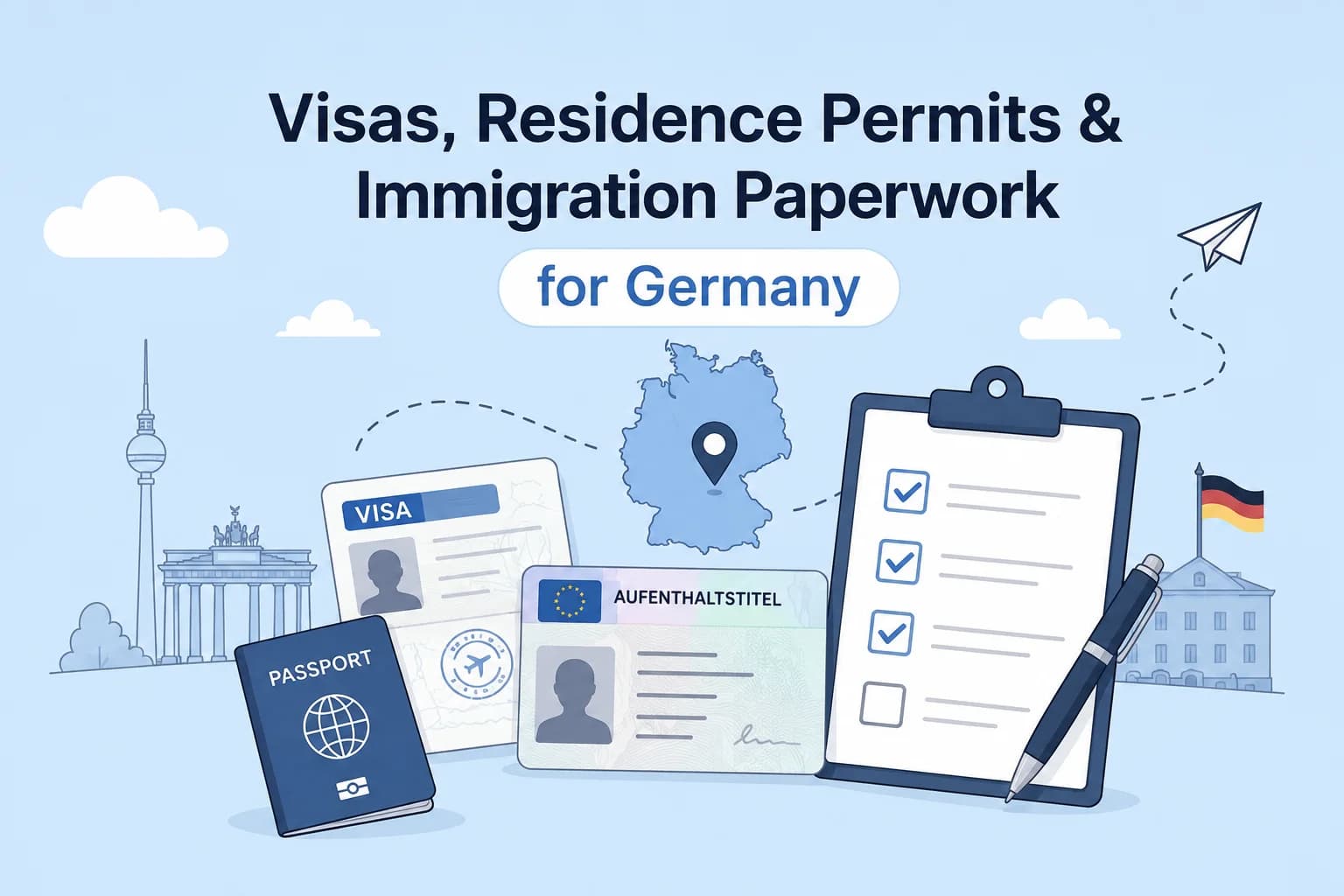
Using the New 'Work-and-Stay' Agency: Germany's Streamlined Expat Hub

9 min read
Job Search StrategyGermany
Using the New 'Work-and-Stay' Agency: Germany's Streamlined Expat Hub
Job Search Strategygermanyimmigrationjobs

The gray stone facade of the Berlin Ausländerbehörde at Friedrich-Krause-Ufer has long served as the physical manifestation of German bureaucratic inertia: imposing, opaque, and notoriously difficult to navigate. For a decade, the ritual for high-level recruits—engineers from Bangalore, data scientists from Palo Alto, and fintech executives from London—involved predawn vigils in the rain, hoping for a walk-in appointment, or months of silence while a paper-heavy dossier moved slowly between municipal desks.

As we move into the 2025/2026 fiscal cycle, that ritual is undergoing a radical, state-mandated decomposition. The catalyst is the "Work-and-Stay" Agency, a centralized hub designed to bypass the traditional bottlenecks of local authorities. For the global professional, the stakes are high. Germany, facing a forecasted labor deficit of seven million workers by 2035, has been forced to pivot from a "gatekeeper" mentality to a "service-provider" model.

The transition is not merely cosmetic. It is an overhaul of the legal machinery governing how non-EU talent enters the Eurozone’s largest economy. However, as the new system scales, early data suggests that while the "red tape" is being digitized, the "red ink" in the form of rising costs and fiscal obligations remains a significant hurdle for the uninitiated.

The Hard Numbers: The 2025/2026 Cost-of-Living Shift

The economic landscape for an expat in Germany has shifted from "affordable European hub" to "high-cost stability play." While inflation has cooled from its 2023 peaks, the IMF’s projections for Germany in 2025 and 2026 suggest a stabilization of consumer price indices (CPI) at approximately 2.1% to 2.3%. However, this macro-stability masks sharp increases in specific sectors critical to the expat experience: housing and healthcare.

The following tables detail the projected monthly expenditure for a single professional in Berlin and Munich, based on data from the Federal Statistical Office (Destatis) and private real estate indices.

Table 1: Monthly Living Expenses (Single Professional, Mid-Career)

Expenditure Category 2024 Actual (Avg) 2025/2026 Projected Trend Analysis
Rent (Warm/Inc. Utilities) €1,450 €1,680 +15.8% (Supply shortage)
Health Insurance (Public) €420 €455 Increased contribution rates
Groceries & Dining €550 €595 Supply chain stabilization
Transport (Deutschlandticket+) €49 €69 Subsidy reductions
Discretionary/Leisure €400 €430 Service sector wage pressure
Total Monthly Spend €2,869 €3,229 +12.5% Aggregate Increase

Table 2: The Salary Threshold for the EU Blue Card

The EU Blue Card remains the gold standard for skilled migration. For 2025 and 2026, the German government has adjusted the salary thresholds downward in real terms to attract a broader talent pool, yet the mandatory social contributions have risen.

Metric 2024 Threshold 2025/2026 Forecast Impact
Standard Blue Card (Gross) €45,300 €46,800 Adjusted for wage growth
Bottleneck Professions €41,041 €42,500 Includes IT, STEM, Medicine
Pension Contribution (%) 18.6% 18.9% - 19.2% Legislative "Rentenpaket II"
Long-term Care Ins. (%) 3.4% 3.6% - 4.0% Aging population levy

Housing remains the primary friction point. In "A-Cities" like Munich, Frankfurt, and Hamburg, the Mietpreisbremse (rent brake) has largely failed to curb costs for new "furnished" contracts, which are exempt from many price caps. Professionals arriving in 2026 should expect to allocate 35-45% of their net income to housing unless they look toward "B-Cities" like Leipzig or Magdeburg, where the Work-and-Stay Agency is actively incentivizing placement.

The Regulatory Landscape: Navigation via the Central Agency

The "Work-and-Stay" Agency is the operational arm of the Fachkräfteeinwanderungsgesetz (Skilled Immigration Act), which entered its final phase of implementation in late 2024. By early 2026, the agency is scheduled to have fully integrated the "Opportunity Card" (Chancenkarte)—a points-based system modeled on the Canadian and Australian systems.

The Opportunity Card (Chancenkarte) 2.0

For the first time in modern German history, a professional can enter the country without a firm job offer. The criteria for 2026 are rigorous:

  • The Point Threshold: Applicants must score at least six points. Points are awarded for professional qualifications (4 points), German language proficiency (up to 3 points), and "age potential" (2 points for those under 35).
  • The Financial Buffer: To prevent "social tourism," the 2026 requirements demand a blocked account (Sperrkonto) containing at least €12,400 per year of stay, a figure adjusted annually based on the BaföG student aid rates.

The Digital Transformation of the Visa Hub

The core value proposition of the Work-and-Stay Agency is the digitalization of the Zustimmung (approval) process. Historically, the Federal Employment Agency (BA) and the local Foreigners’ Authority worked in silos. According to the Ministry of the Interior's 2025 roadmap, the new centralized digital portal aims to reduce the "time-to-visa" from an average of four months to 30 days for priority sectors.

However, a caveat remains for 2026: while the federal portal is streamlined, the final "stamping" of the visa still occurs at the local consulate or embassy level. Our analysis of current processing times in New Delhi and São Paulo suggests that consular staffing levels have not yet matched the speed of the digital backend, creating a "digital-analog bottleneck."

Healthcare and the Social Safety Net: A Cost-Benefit Analysis

Germany’s healthcare system, often lauded for its universality, is facing a fiscal reckoning in 2026. For the high-earning expat, the choice between Public (Gesetzliche Krankenversicherung - GKV) and Private (Private Krankenversicherung - PKV) insurance has never been more consequential.

For 2026, the "Assessment Ceiling" (Beitragsbemessungsgrenze)—the maximum income level used to calculate social security contributions—is projected to rise to approximately €64,000. This means high-earners will see a higher portion of their salary deducted for health and nursing care.

  • The Public Trap: Those earning over €70,000 often find themselves paying the maximum GKV rate (roughly €950-€1,050 per month, split with the employer).
  • The Private Alternative: In 2025/2026, private insurers have been authorized to implement "risk adjustments" based on the increased cost of medical technology. While initially cheaper for young, healthy expats, the long-term premium trajectory in a high-inflation environment requires careful modeling.

Local "On the Ground" Insight: The Cultural Shift

Beyond the data, the reality of living in Germany in 2026 involves navigating a society in the midst of a cultural recalibration. The "Welcome Culture" (Willkommenskultur) of the previous decade has been replaced by a "Pragmatic Integration" model.

The "Termin" Economy Despite digitalization, the concept of the Termin (appointment) remains the bedrock of German life. However, a new sub-economy has emerged: "Termin-hunting" software. Sophisticated expats are now using API-based scrapers to secure appointments at the Work-and-Stay Agency the moment they are released at 7:00 AM. For those without technical skills, specialized relocation consultants are charging upwards of €500 just to secure a slot for a residence permit extension.

The Language Barrier vs. The English Bubble In Berlin and Munich, it is entirely possible to work in English. However, the 2026 labor market data indicates that "career velocity"—the speed at which one is promoted—remains 40% slower for those without B2-level German. The Work-and-Stay Agency has recognized this by bundling "Language Vouchers" with visas for 2026, a policy designed to move expats out of the "startup bubble" and into the more lucrative Mittelstand (medium-sized enterprises) sector.

Insurance as a Lifestyle A nuance often missed by newcomers is the German obsession with Haftpflichtversicherung (personal liability insurance). In a society where "damages" are litigated with precision, 2026 data shows that 85% of long-term expats now carry this coverage. At roughly €5-€10 a month, it is an essential, if invisible, part of the local social contract.

Actionable Outlook: The 12-24 Month Strategy

For the professional considering a move to Germany between now and late 2026, the environment requires a tactical approach. The days of "moving and figuring it out" are over; the new system rewards those who treat their relocation like a corporate merger.

1. Leverage the "Pre-Approval" (Vorabzustimmung)

The Work-and-Stay Agency offers a "fast-track procedure for skilled workers" (Beschleunigtes Fachkräfteverfahren). Employers can initiate this for a fee of €411. In the 2026 market, this is no longer optional; it is a prerequisite for any professional wanting to avoid the general processing pool. Ensure your employer commits to this in the contract negotiations.

2. The Tax Class Optimization

Germany’s tax system (Classes I through VI) can fluctuate take-home pay by hundreds of euros. Following the 2025 tax reforms, the "splitting" benefit for married couples (Classes III and V) is under legislative review and may be replaced by a more neutral Class IV/IV system. Expats should run 2026 simulations using Brutto-Netto calculators that account for the new Rentenpaket II deductions to ensure their net income covers the aforementioned housing surges.

3. The Housing "Side Door"

Given the 2026 rental forecasts, the traditional route of finding an apartment on ImmobilienScout24 is increasingly futile for those without a three-month German salary history (Gehaltsnachweis). The strategic move is to negotiate a "relocation allowance" or corporate housing for the first six months. This allows the expat to build the necessary credit history (SCHUFA) to compete in the local market.

4. Digital Sovereignty

The Work-and-Stay Agency expects high-level digital literacy. Ensure all professional certifications, degree transcripts, and marriage certificates are digitally notarized and translated by state-certified translators (Staatlich geprüfte Übersetzer) before arrival. The 2026 digital portal uses AI-driven document verification; any discrepancy in naming conventions or dates can trigger an automatic 60-day "human review" delay.

Germany in 2026 presents a paradox. It is simultaneously the most accessible it has ever been from a regulatory standpoint and the most challenging from a cost and bureaucratic-precision standpoint. The Work-and-Stay Agency is a powerful tool, but it is a tool for the prepared. Those who master the "Hard Numbers" and the digital nuances of the new system will find a high-stability, high-reward environment. Those who rely on the "old ways" of navigating the Ausländerbehörde will find themselves left behind in the rain.

Subscribe to Our Newsletter

Welcome to our newsletter hub, where we bring you the latest happenings, exclusive content, and behind-the-scenes insights.

*Your information will never be shared with third parties, and you can unsubscribe from our updates at any time.