AD
VocabAI The only app an expat needs • Learn easy
INSTALL

Top AI Language Apps for Learning German and Swedish on the Go

8 min read
0Language LearningGermany
Top AI Language Apps for Learning German and Swedish on the Go

For the professional relocating to Berlin or Stockholm, the traditional "language learning" arc has long been a source of quiet friction. The discrepancy between a high-functioning executive’s professional competence and their playground-level linguistic ability creates a psychological tax that few generic apps have managed to mitigate. However, as we move into 2026, the arrival of ultra-low-latency speech-to-speech models has fundamentally altered the utility of mobile learning. We are no longer in the era of "streaks" and gamified vocabulary cards; we are in the era of the high-fidelity simulator.

executive professional learning language on smartphone on a high-speed train

The current landscape of German and Swedish instruction for the time-poor professional is defined by three shifts: the obsolescence of translation-based learning, the rise of "narrow-domain" fluency, and the integration of real-time corrective feedback that mimics a human tutor without the scheduling overhead. For the expat, the goal is rarely poetic mastery; it is the ability to navigate a residency permit meeting at the Landesamt für Einwanderung or to decipher the nuanced social codes of a Swedish fika without defaulting to English.

modern minimalist office building in Stockholm or Berlin

The German Challenge: Precision and Protocol

German remains a Language where structural precision is non-negotiable. For many expats, the initial hurdle isn't vocabulary—which often shares roots with English—but the architectural complexity of the four cases and gendered nouns. In early 2026, the market leaders have pivoted toward solving this through generative grammar engines. Unlike older apps that relied on pre-scripted paths, newer platforms use Large Language Models (LLMs) to generate dynamic scenarios.

Berlin architecture Landesamt für Einwanderung exterior

TalkPal AI and Langua have emerged as the dominant tools for professionals targeting the DACH region (Germany, Austria, Switzerland). Their value proposition lies in "Roleplay Mode." A user can simulate a salary negotiation or a conversation with a landlord. The AI does not merely wait for a keyword; it evaluates the nuance of the response. If you use the Dative case when the Accusative was required, the feedback is immediate and contextual. For an expat, this replaces the embarrassment of a real-world error with a low-stakes digital rehearsal.

close up of AI language app interface showing German grammar correction

The risk with German AI tools remains the "hallucination" of grammar rules. While the underlying models (typically versions of GPT-4o or projected GPT-5 iterations) are highly proficient, they can occasionally provide inconsistent justifications for the more esoteric rules of German syntax. Professionals should use these tools as "fluency lubricants" rather than definitive grammatical authorities. The most effective strategy involves using an AI partner for 15 minutes of verbal sparring during a commute, supplemented by a structured reference like Hammer’s German Grammar for structural verification.
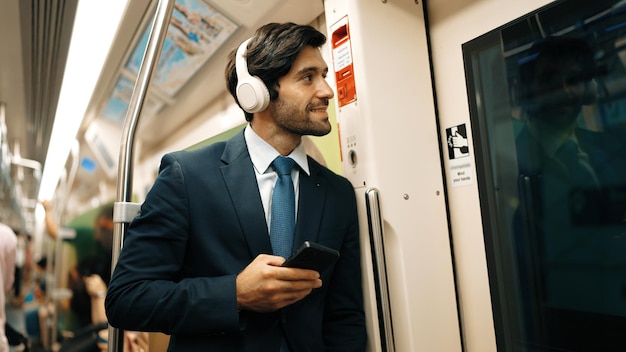

professional man commuting on Berlin U-Bahn using noise-canceling headphones

The Swedish Context: The Pitch and the Social Barrier

Swedish presents a different set of obstacles. While the grammar is significantly simpler than German, the phonology is notoriously difficult for English speakers to master. Swedish is a pitch-accent language; the meaning of a word can shift based on the tonal contour. Furthermore, the "social barrier" in Sweden is high—most Swedes speak excellent English and will switch the moment they detect a struggle, which effectively halts the expat’s progress.

Stockholm street scene with people walking in winter light

Babbel has integrated sophisticated AI speech recognition that focuses specifically on prosody and intonation, which is vital for Swedish. In its 2025 updates, the platform moved beyond simple "right/wrong" pronunciation checks to heat-map visualizations of a user’s pitch. For a professional in Stockholm, sounding "Swedish" is less about perfect vocabulary and more about the "sing-song" rhythm that signifies cultural integration.

visual representation of voice frequency and pitch accent waves

Another emergent tool, Pimsleur’s updated AI-driven voice interface, remains a favorite for the "on the go" category. It utilizes a hands-free, purely auditory method that is particularly effective for Swedish because it forces the ear to tune into the melodic shifts of the language. For the professional driving to an office in Kista or walking through Södermalm, this removes the "screen friction" entirely.

modern Swedish technology park in Kista Stockholm

The Institutionalization of AI Tutors

A significant development expected to solidify in late 2026 is the integration of these apps into corporate relocation packages. HR departments at firms like Siemens, Ericsson, and Spotify are moving away from providing "one-size-fits-all" classroom instruction. Instead, they are subsidizing premium tiers of AI-native platforms that offer "Professional Swedish" or "Legal German" modules.

HR professional discussing relocation benefits with a new hire

These specialized modules allow for the ingestion of industry-specific jargon. An engineer moving to Stuttgart can feed the AI a series of technical manuals (within data privacy constraints), and the AI will then tutor them specifically on the vocabulary of automotive fluid dynamics or semiconductor manufacturing. This "narrow-domain" approach ensures that the expat is functional in their specific professional niche long before they can discuss 19th-century literature.

industrial engineering facility in Germany interior

Data Privacy and the Executive Risk

For high-level professionals, the use of AI language apps introduces a specific category of risk: data leakage. Most AI-based language apps operate in the cloud. Conversations held for "practice" are often used to further train the underlying models. An executive practicing a sensitive presentation in Swedish or German might inadvertently disclose proprietary information to the service provider.

digital security and data privacy icon on a dark background

As of 2026, the discerning expat should look for "Enterprise" or "Private Mode" settings. Platforms like Preply, which has integrated AI-driven homework and prep tools alongside human tutors, are beginning to offer localized data processing. This ensures that the voice recordings and text inputs remain within EU jurisdictions, adhering to GDPR standards which are particularly stringent in Germany.

GDPR compliance logo on a modern glass office door

The Hybrid Model: Moving Beyond the Phone

The most successful professionals are not using these apps in a vacuum. They are using them as a "bridge" to high-level human interaction. The prevailing mental model for 2026 is the 80/20 split: 80% of the "grind" (vocabulary acquisition, grammar repetition, and pronunciation drills) is handled by AI on the go, while the remaining 20% is reserved for high-value human coaching to navigate the "cultural ghosts" in the language—the idioms and social cues that AI still lacks the lived context to fully grasp.

professional meeting with a language coach in a cafe

In Sweden, this means using AI to master the en/ett noun genders and the pitch accent, then using a human coach to understand when it is appropriate to use du (the universal "you") versus the rare, formal ni. In Germany, the AI handles the Konjunktiv II drills, while the human coach helps the professional understand the subtle difference between being "direct" and being "rude" in a boardroom setting.

diverse group of professionals having a meeting in a glass-walled conference room

A Warning on the "Fluency Illusion"

The primary danger of the current generation of AI language apps is the "fluency illusion." These tools are designed to be frictionless; they are highly encouraging and rarely "give up" on a user. This can lead to a false sense of security. An expat may feel they are communicating effectively with an AI that is programmed to understand them, only to find that a real-world bureaucrat or a busy colleague is far less forgiving.

frustrated person trying to communicate with someone in a foreign language

To calibrate effectively, professionals should intentionally "stress-test" their progress. This means moving from the "supportive" AI environment to "unfiltered" audio environments as soon as possible. Listening to the Tagesschau (Germany) or Sveriges Radio at 1.0x speed without subtitles remains the gold standard for testing whether the "on the go" learning is actually translating into real-world comprehension.

radio broadcasting studio interior

Practical Trajectory for the Next 12 Months

For those arriving in Berlin or Stockholm in the coming months, the recommended stack is specific.

  1. For German: Prioritize Langua for its ability to generate "live" transcripts of your spoken errors and Lingvist for its data-driven approach to vocabulary frequency. The latter uses a "knowledge map" to ensure you aren't wasting time on words you will never use in a professional context.
  2. For Swedish: Utilize Babbel’s speech-focus modules and SVT Språkplay, a tool provided by the Swedish public broadcaster that turns news and television into interactive AI lessons.
  3. The "Commute Hack": Set your phone’s OS to the target language. This forces the AI assistants (Siri/Google) to operate in German or Swedish, turning every basic interaction—setting a calendar invite or checking the weather—into a micro-lesson.

smartphone screen showing German language settings

The shift from 2025 into 2026 is defined by the end of the "language app" as a standalone product and its rebirth as a persistent, ambient coach. The professional who masters these tools does not just learn a language; they reduce the "latency" of their integration into a new society. In the high-stakes world of global mobility, that time saved is the only currency that truly matters.

time-lapse of a busy European city square at sunset

Subscribe to Our Newsletter

Welcome to our newsletter hub, where we bring you the latest happenings, exclusive content, and behind-the-scenes insights.

*Your information will never be shared with third parties, and you can unsubscribe from our updates at any time.

Comments

0/2000