City Registration (Anmeldung), Proof of Residence & Obtaining Your Tax ID

·
8 min read
·
AI
·Written by Rosey

A step-by-step administrative guide to registering your address at the Bürgeramt, obtaining the Wohnungsgeberbestätigung, and receiving your Tax ID (Steuer-ID).

City Registration (Anmeldung), Proof of Residence & Obtaining Your Tax ID

City Registration (Anmeldung), Proof of Residence & Obtaining Your Tax ID

Moving to Germany involves several initial administrative steps. The most fundamental of these is registering your residential address, a process known as Anmeldung.

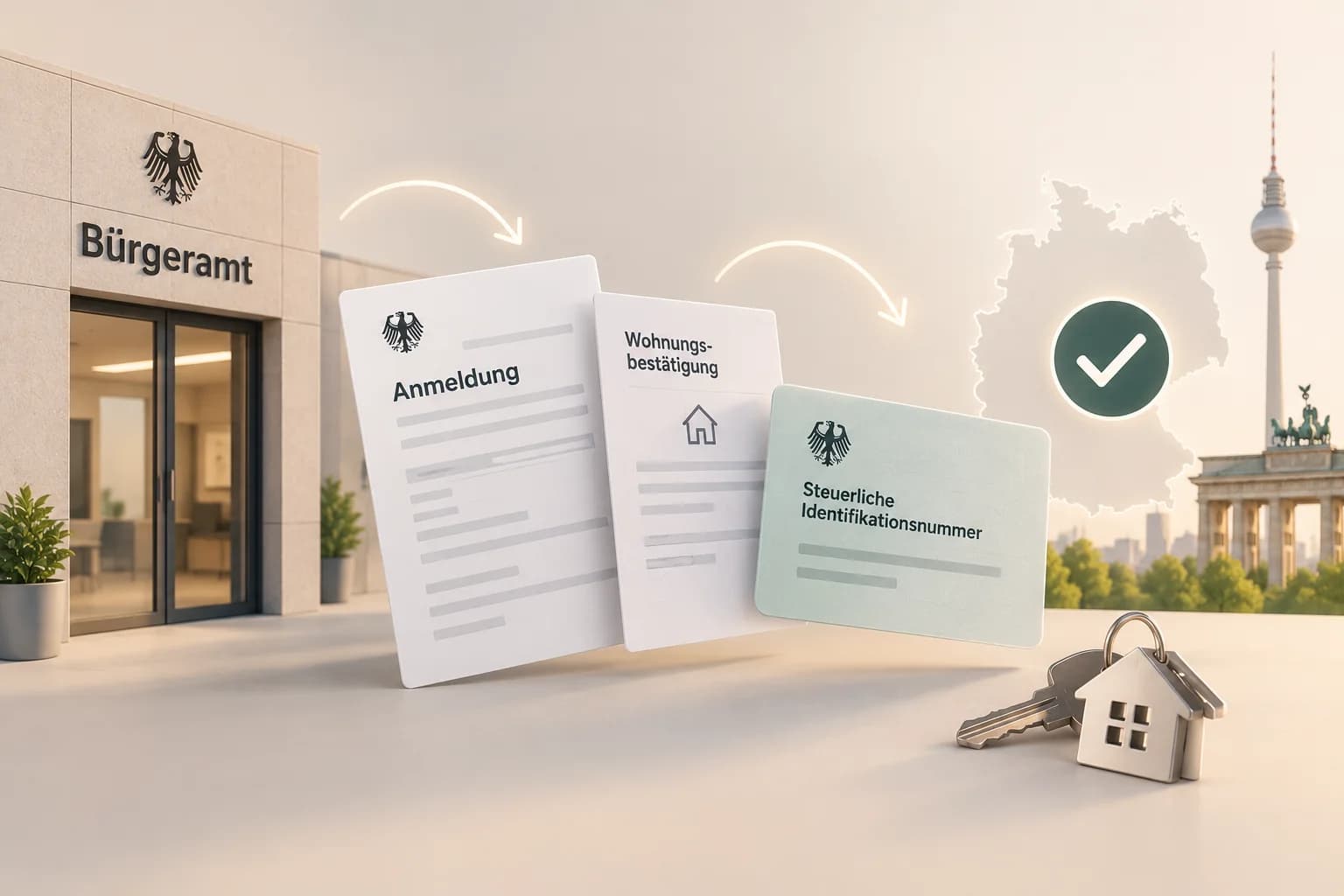
This guide explains the registration process, how to obtain your proof of residence (Wohnungsgeberbestätigung), and how this process automatically triggers the issuance of your German Tax ID (Steueridentifikationsnummer).


Understanding the Core Concepts

German administrative systems operate on the principle of local registration. Every resident—whether a local citizen or an international newcomer—is legally required to maintain an updated registered address with the municipal authorities.

What is Anmeldung?

Anmeldung simply translates to "registration." It is the official process of notifying the local registry office (Bürgeramt or Bürgerbüro) of where you live.

Upon successful registration, you receive a registration certificate (Meldebescheinigung). This document is essential for daily administrative life in Germany and is typically required to:

  • Open a traditional German bank account
  • Sign utility and internet contracts
  • Obtain a mobile phone contract
  • Register for public or private health insurance
  • Apply for or extend a residence permit (Aufenthaltstitel)

What is the Wohnungsgeberbestätigung?

You cannot register an address simply by presenting a lease agreement (Mietvertrag). German law requires a specific form signed by your landlord or primary tenant, called the Wohnungsgeberbestätigung (Housing Provider Confirmation). This document confirms that you have actually moved into the property on a specific date.

What is the Steueridentifikationsnummer (Tax ID)?

Often abbreviated as Steuer-ID or IdNr, this is a unique, permanent 11-digit number assigned to you for life by the Federal Central Tax Office (Bundeszentralamt für Steuern or BZSt). It is used to determine your tax bracket and process your income tax. Your first Anmeldung automatically triggers the generation of this ID.

Who Must Register and When?

The obligation to register applies to almost everyone establishing a residence in Germany.

Category Registration Rule
Long-term Residents (Expats, Employees, Students) Typically required to register within 14 days of moving into a permanent home.
Short-term Visitors (EU citizens) Generally exempt if staying in the country for less than three months, unless they take up employment.
Short-term Visitors (Non-EU citizens) Generally tied to visa conditions, but registration is required once permanent housing is secured or employment begins.

Note: While local laws technically require registration within 14 days of moving in, many major cities experience high demand for appointments. Authorities are generally understanding of delays, provided you book the first available appointment within a reasonable timeframe.


Step 1: Obtain the Wohnungsgeberbestätigung

Before booking your registration appointment, you must secure your proof of residence. Your landlord (Vermieter) is legally obligated to provide this document within two weeks of your move-in date.

Who signs the form?

  • If you rent directly from a landlord: The landlord or their authorized property management company (Hausverwaltung) signs it.
  • If you sublet a room from a primary tenant: The primary tenant (Hauptmieter) signs it. In this case, the primary tenant acts as the housing provider (Wohnungsgeber). Note that the landlord's permission for subletting is usually required beforehand.
  • If you stay in temporary serviced apartments or co-living spaces: The provider’s administration team must issue this document. Standard hotels and holiday rentals typically do not issue this form unless your stay exceeds a specific duration (often three months).

Required details on the form:

  1. Name and address of the housing provider (landlord or primary tenant).
  2. Date of move-in.
  3. Address of the rented property.
  4. Names of all individuals moving into the apartment.
  5. Signature of the housing provider.

Step 2: Book an Appointment (Termin)

To register, you must visit a local registry office. Depending on the municipality, these offices are called Bürgeramt, Bürgerbüro, Kundenzentrum, or Rathaus.

How to book:

  1. Online portals: Most cities (such as Berlin, Munich, Hamburg, and Frankfurt) run centralized online booking systems. Look for the service labeled Wohnung anmelden or Anmeldung einer Wohnung.
  2. Telephone: In many regions, you can dial the nationwide public service number 115 to book an appointment over the phone.
  3. In-person/Walk-ins: Some smaller towns allow walk-ins, but major cities almost exclusively require pre-booked appointments.

Practical Tip: If no appointments are visible online, try checking the municipal website early in the morning (between 7:00 AM and 8:00 AM local time). Many offices release cancelled appointments or same-day slots during these hours.


Step 3: Gather Required Documents

Bring physical copies of all documents to your appointment. Digital copies on a smartphone are rarely accepted by municipal officers.

Document Description
Valid Passport or National ID card Required for all registering family members.
Wohnungsgeberbestätigung The completed and signed landlord confirmation form.
Registration Form (Anmeldeformular) Completed and signed. Many cities provide a PDF download on their booking portal.
Visa or Residence Permit If applicable (for non-EU/EEA citizens).
Civil Status Certificates Marriage certificate, birth certificates of children (if registering as a family). International documents may need a certified German translation or an apostille depending on country-of-origin rules.

Step 4: Attend the Appointment

On the day of your appointment, arrive slightly early at the designated Bürgeramt.

What to expect at the office:

  • Locate the waiting area and look at the overhead screens for your ticket number.
  • Once called, hand your documents to the administrative clerk.
  • The clerk will enter your data into the national registry system.
  • The Church Tax Question: During the appointment, you will be asked about your religious affiliation. If you declare a religion that is officially recognized by the state (such as Roman Catholic or Protestant), you will be subject to German church tax (Kirchensteuer), which is calculated as a percentage of your income tax. If you have no religious affiliation, you can state konfessionslos (no religion).
  • The clerk will print your registration certificate (Meldebescheinigung) immediately. Review it carefully to ensure your name, date of birth, and address are spelled correctly before leaving.

Costs

In most German municipalities, the address registration process is entirely free of charge. A small administrative fee (usually between €10 and €15) may apply in certain municipalities or if you require multiple physical copies of the certificate.


Step 5: Receive Your Tax ID (Steueridentifikationsnummer)

Once your address is registered in the municipal database, the local office automatically transmits your information to the Federal Central Tax Office (Bundeszentralamt für Steuern).

The Timeline

  • Your Tax ID is generated and sent to your registered address via physical postal mail.
  • This process typically takes two to four weeks after your Anmeldung appointment.
  • The tax authorities will not send this information via email or phone due to strict data privacy regulations.

What if it does not arrive?

If you do not receive your Tax ID within four to six weeks, you can request it through the portal of the Bundeszentralamt für Steuern (BZSt). Alternatively, you can visit your local finance office (Finanzamt) in person with your passport and Meldebescheinigung to request it.

Your Employer and Your Tax ID

Your employer requires your Tax ID to calculate your correct tax class (Steuerklasse) and process your payroll. If you start working before your Tax ID arrives, your employer may temporarily place you in the highest tax bracket (Tax Class 6). Any overpaid tax is typically refunded once you provide your correct Tax ID and file your annual tax return.


Common Administrative Pitfalls to Avoid

  • Renting without registration option: Some temporary sublets do not allow Anmeldung (often because the landlord is unaware of the sublet, or it is an unauthorized rental). Ensure your accommodation provider explicitly agrees to sign the Wohnungsgeberbestätigung before signing a rental agreement.
  • Missing name on the mailbox: In Germany, postal workers deliver mail based on the last name listed on the physical mailbox, not the apartment number. Ensure your surname is clearly placed on your apartment's physical mailbox immediately after registering, otherwise your Tax ID letter and other vital administrative mail will be returned to the sender.
  • Assuming the lease contract is sufficient: Showing a signed rental contract instead of a Wohnungsgeberbestätigung will result in your registration application being turned down, requiring you to book another appointment.
  • Failing to register changes: If you move to a new apartment within the same city, you must complete the process again (this is called Ummeldung). If you leave Germany permanently, you must de-register your address (Abmeldung) before your departure.

Next Steps After Registration

Once you hold your Meldebescheinigung and receive your Tax ID, you have established your legal foundation in Germany. You can now confidently proceed with:

  1. Setting up a bank account: Most traditional and digital-first banks require your Meldebescheinigung.
  2. Submitting details to your employer: Provide your Tax ID and German bank details to secure proper payroll setup.
  3. Completing your residence permit application: If you are a non-EU citizen, the immigration office (Ausländerbehörde) requires your registration certificate to finalize your residency status.
  4. Paying the Broadcasting Fee (Rundfunkbeitrag): Shortly after registering, every household receives a letter requesting payment for the mandatory public broadcasting contribution. This is a standard fee billed per apartment, regardless of whether you own a television or radio.
R

Rosey

Thinker, student & movie-lover

STAY CONNECTED WITH THE EXPAT COMMUNITY

Subscribe to get expat tips, local insights, and connect with professionals around the world.