Banking, Mobile Plans & Utility Setup for New Residents in Germany

·
8 min read
·
AI
·Written by Sajad

Opening your first current account (Girokonto), choosing mobile phone providers, and contracting electricity, gas, and home internet services.

Banking, Mobile Plans & Utility Setup for New Residents in Germany

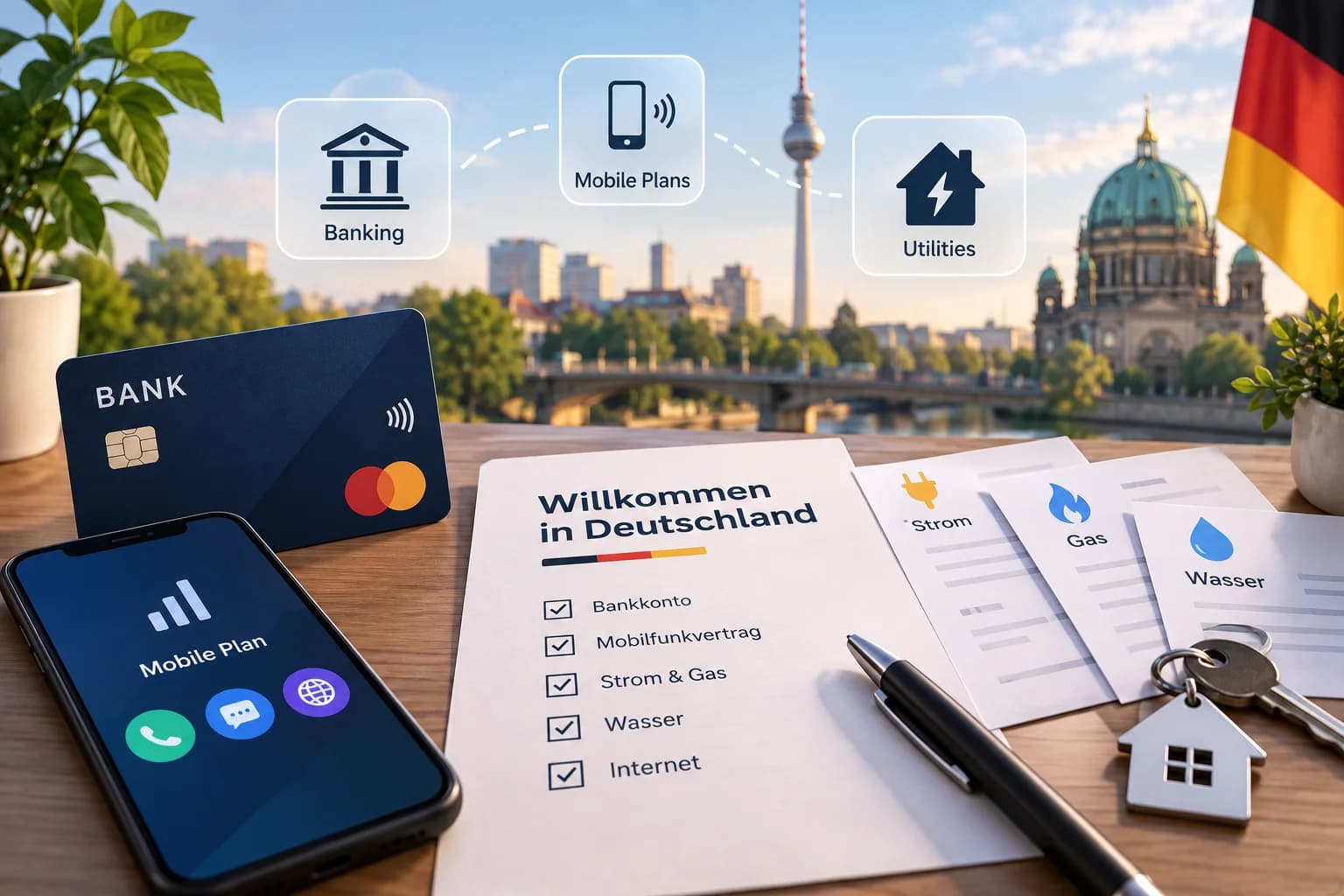
Relocating to Germany requires navigating a structured sequence of administrative and practical setups. To establish a household, new residents must typically secure a bank account, establish mobile connectivity, and register for home utilities.

These processes are highly interdependent. For example, contracting for utilities or mobile plans usually requires a German bank account, which in turn often requires a registered address (Anmeldung). Understanding these systems from first principles ensures a smoother transition.


The Prerequisites: Address Registration (Anmeldung)

Before contracting most services in Germany, you generally need an address registration certificate (Meldebescheinigung).

Upon moving into a home, residents are legally required to register their address at the local citizens' office (Bürgeramt) within two weeks. When you register, you receive the Meldebescheinigung. This document, alongside a valid passport or national ID, serves as the primary proof of residence required by banks, utility companies, and telecommunications providers.


1. Banking in Germany (Das Girokonto)

A current account (Girokonto) is the foundation of daily financial transactions in Germany. Salaries are paid into it, and rent, utilities, and insurances are typically paid out of it via direct debit (Lastschrift).

Types of Banks

German retail banking is broadly split into two models:

Feature Traditional Banks (Filialbanken) Online Banks (Direktbanken)
Examples Sparkasse, Volksbank, Commerzbank, Deutsche Bank N26, DKB, Comdirect
Physical Branches Yes, extensive physical presence No, online/app only
Customer Service In-person and phone (mostly German) App, chat, and phone (often multilingual)
Fees Typically monthly account maintenance fees Often free basic accounts, subject to conditions
ATM Access Free within their specific cash group Often free at any ATM with a Visa/Debit card

Key Requirements & Documents

  • Valid Passport or ID card (some banks do not accept certain foreign passports via online verification).
  • Registration Certificate (Meldebescheinigung).
  • Visa or Residence Permit (for non-EU/EEA citizens).
  • Tax Identification Number (Steueridentifikationsnummer) (can often be provided within a few weeks after opening).

Step-by-Step Opening Procedure

  1. Choose a Provider: Select a traditional or online bank based on your language preferences and branch accessibility.
  2. Submit Application: Complete the online form or book an appointment at a local branch.
  3. Verify Identity:
    • In-Person: Present documents to a bank clerk.
    • VideoIdent: Verify identity via a video call with a service provider using your passport.
    • PostIdent: Take a printed coupon and your passport to a Deutsche Post branch for verification.
  4. Receive Account Details: Once approved, your IBAN will be issued. Cards (Girocard/Debit card) and PINs are mailed separately in multiple letters for security purposes.

Timelines & Costs

  • Timeline: Online accounts can be active within 24 to 48 hours; physical cards generally arrive within 5 to 10 business days. Traditional bank setups during in-person appointments may take up to a week for full activation.
  • Costs: Account fees range from €0 to €15 per month. Be aware of cash withdrawal limits and foreign transaction fees.

2. Mobile Phone Plans (Mobilfunk)

Germany offers a robust mobile network ecosystem. To obtain a SIM card, all users must complete a mandatory identity verification process mandated by federal security laws.

Contract Types

  • Prepaid SIM Cards: No long-term commitment. You top up credit as needed. Ideal for immediate use upon arrival.
  • Postpaid Contracts (Laufzeitvertrag): Typically run for 24 months. These plans often offer better data packages and subsidized hardware, but require a German bank account and a credit check.

Network Operators vs. MVNOs

Three major companies operate the physical mobile networks in Germany: Deutsche Telekom, Vodafone, and Telefónica (O2).

Mobile Virtual Network Operators (MVNOs) lease space on these networks and often offer lower prices under discount brands (e.g., ALDI Talk, Lidl Connect, Blau, Congstar, Otelo).

  • Telekom Network: Generally recognized for high coverage density, especially in rural areas, often at a premium price point.
  • Vodafone Network: Strong urban and rural coverage, mid-to-high price range.
  • Telefónica Network: High speeds in urban centers, generally competitive pricing, though coverage in remote areas can vary.

Setup Procedure

  1. Purchase: Buy a prepaid card at a supermarket or order a contract/prepaid card online.
  2. Identification: Register the SIM card using your passport or national ID via VideoIdent (app) or PostIdent (post office).
  3. Activation: SIM cards are typically activated within a few hours of successful identification.

3. Utilities: Electricity and Gas (Strom & Gas)

In Germany, utility markets are fully liberalized, meaning consumers are free to choose their energy providers.

The Default Supply (Grundversorgung)

When you move into a new apartment and turn on the lights, electricity is immediately available. This is because the local default provider (Grundversorger—usually the municipal utility, or Stadtwerke) automatically supplies the property.

While convenient, the Grundversorgung tariff is typically the most expensive option. It is advisable to sign a contract with an alternative provider or choose a cheaper tariff from the default provider as soon as possible.

The Billing Model (Abschlag)

German utility providers use an installment billing system:

  • Monthly Installments (Abschlag): You pay a fixed estimated amount each month based on expected annual consumption.
  • Annual Reading (Jahresabrechnung): Once a year, the actual meter reading is submitted. If you used less energy than estimated, you receive a refund. If you used more, you receive an invoice for the difference, and your monthly Abschlag is adjusted upward for the following year.

Step-by-Step Utility Registration

  1. Locate Meters: Find the electricity (and gas, if applicable) meters, typically located in the basement or inside the apartment.
  2. Record Details on Handover: On your moving-in day, note down the Meter Number (Zählernummer) and the current Meter Reading (Zählerstand) on your apartment handover protocol (Übergabeprotokoll).
  3. Compare Rates: Use online comparison engines to evaluate energy suppliers.
  4. Register: Sign up with your chosen provider online. You will need:
    • Your German IBAN for payment.
    • The meter number.
    • The moving-in date.
    • Estimated annual consumption (usually estimated based on household size).
  5. Cancellation of Old Contract: If switching, your new provider will typically handle the cancellation with the default supplier on your behalf.

4. Home Internet (Festnetz & Internet)

Securing a reliable home internet connection can take time in Germany. Plan this step as early as possible.

Available Technologies

  • DSL: Delivered via traditional telephone lines. Highly available, with speeds usually up to 250 Mbps.
  • Cable (Kabel): Delivered via coaxial cable TV lines. Offers speeds up to 1,000 Mbps, but performance can sometimes degrade during peak usage hours in densely populated buildings.
  • Fiber Optic (Glasfaser): The fastest and most reliable technology, though availability is still expanding and may not be present in older buildings.

Standard Contract Terms

Most fixed-term internet contracts in Germany carry a 24-month minimum term. Under consumer protection laws, if a contract is not terminated before the end of this period, it typically transitions to a month-to-month rolling contract, allowing easier cancellation.

Setup Procedure & Timeline

  1. Check Availability: Enter your address on major provider websites (Telekom, Vodafone, O2, 1&1) to see which technologies and speeds are available at your specific building.
  2. Order Online: Select a plan and place the order.
  3. Technician Appointment: If the line is inactive, a technician from Deutsche Telekom (who owns most of the physical line infrastructure) may need to visit your home to activate the port. This often requires waiting at home during a designated time window.
  4. Hardware Installation: Connect the router (either rented from the provider or purchased independently) once the line is activated.

Note: The lead time for home internet installation can range from one to four weeks, depending on technician availability.


Key Legal Frameworks & Common Pitfalls

Navigating contracts in Germany requires awareness of specific consumer protection laws and structural systems.

SCHUFA (German Credit Bureau)

The SCHUFA is Germany's primary credit investigation company. It tracks your payment history and assigns a credit score.

  • Impact: When you apply for a postpaid mobile contract, internet plan, or energy contract, the provider will run a SCHUFA query.
  • For New Arrivals: Because you are new to the country, your credit history will be blank. This lack of data can sometimes cause automated systems to reject high-tier postpaid phone contracts or expensive phone financing plans. Starting with prepaid services or basic utility contracts helps build a positive credit history over time.

Contract Renewal and Cancellation Rules

Germany has strict rules regarding contract termination (Kündigung).

  • The "Kündigungsfrist" (Notice Period): For standard 24-month contracts, you must typically submit a written cancellation notice (often via an online button or email) at least one month before the contract end date.
  • Automatic Extensions: If you miss the cancellation window, contracts generally renew automatically on a monthly rolling basis under current consumer protection regulations, rather than extending for an entire year as was common in the past.

Summary Checklist for New Residents

  1. Register your address at the Bürgeramt to get your Meldebescheinigung.
  2. Open a Girokonto using your passport and registration certificate.
  3. Get a temporary prepaid SIM card to ensure immediate phone and data access.
  4. Locate your utility meters, note the readings, and sign up for an electricity contract to avoid high default rates.
  5. Check home internet availability and order your connection early to account for potential installation lead times.
S

Sajad

German tech savvy, like to explore more about AI & how it works.

STAY CONNECTED WITH THE EXPAT COMMUNITY

Subscribe to get expat tips, local insights, and connect with professionals around the world.