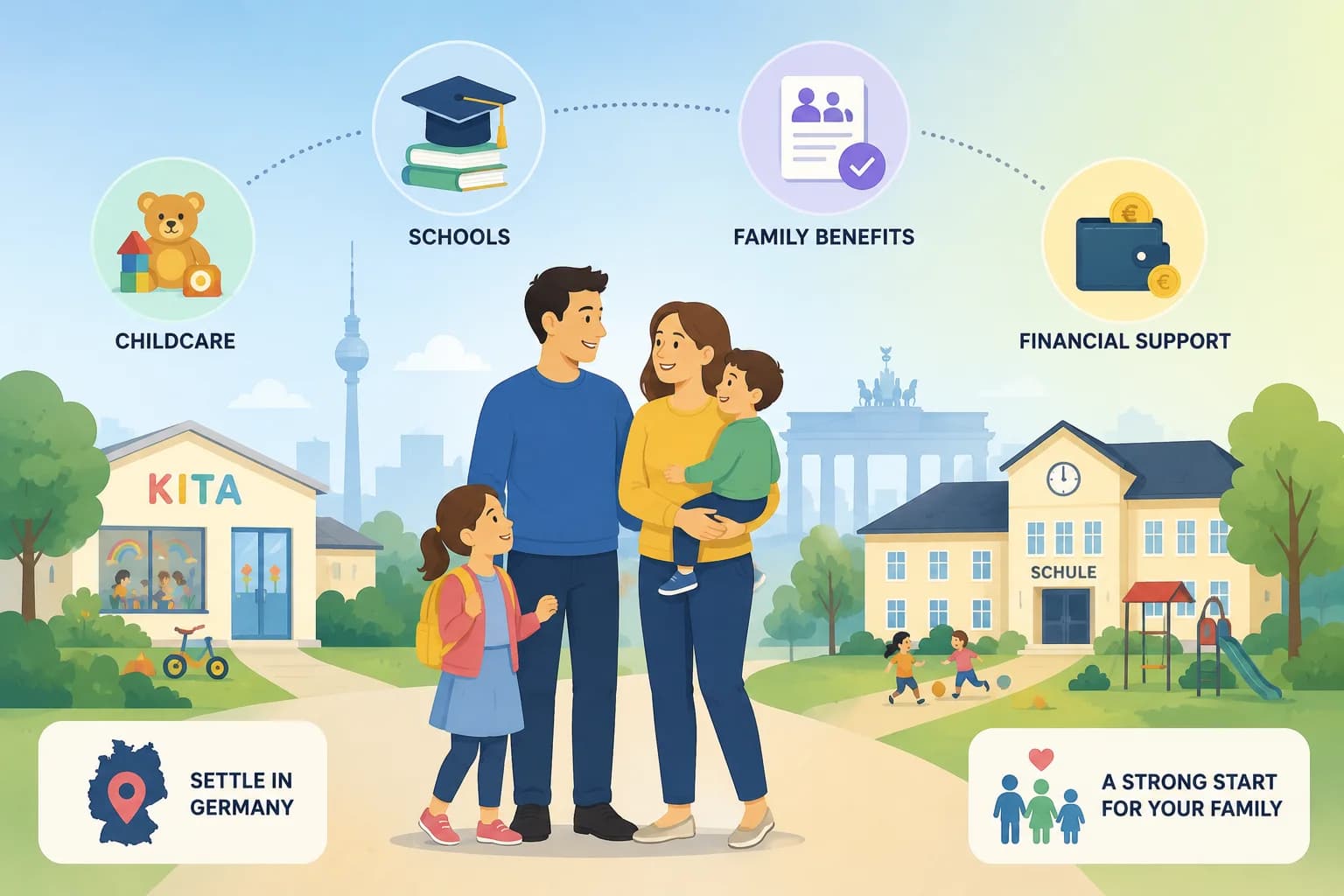
Childcare, Schools & Family Benefits: Settling Your Family in Germany

·
9 min read
·

Navigating the German school system, international school options, Kita daycare vouchers, and applying for state child benefits (Kindergeld).

Childcare, Schools & Family Benefits: Settling Your Family in Germany

Relocating to Germany with a family involves navigating a highly decentralized administrative system. Responsibility for schools and childcare rests primarily with the 16 individual federal states (Bundesländer) and local municipalities (Kommunen). This guide outlines the structure of German childcare, the school system, and available family financial benefits, providing clear pathways to help your family settle smoothly.


Early Childhood Education and Childcare (Kita)

In Germany, daycare is generally referred to as Kita (short for Kindertagesstätte). While early childhood education is not compulsory, children over the age of one have a legal right (Rechtsanspruch) to a subsidized childcare place. However, actual availability varies significantly by region, and demand often exceeds supply.

Types of Childcare

  • Kinderkrippe (Crèche): For children aged 0 to 3 years.
  • Kindergarten: For children aged 3 to 6 years (until they start primary school).
  • Tagespflege (Tagesmutter/Tagesvater): Childminding services, typically organized in small groups of up to five children within a private home or dedicated space, primarily for children under 3.
  • Hort: After-school care for primary school children.

The Kita Voucher (Kita-Gutschein) System

In several federal states (such as Berlin and Hamburg), parents must apply for a childcare voucher (Kita-Gutschein) before registering at a facility. This voucher states the number of subsidized hours your child is entitled to per day, based on your working hours and family situation. The local youth welfare office (Jugendamt) issues this voucher.

In other states, parents apply directly to the daycare centers or use a centralized municipal online portal (often called Little Bird or a similar municipal registration platform).

Costs

Publicly subsidized childcare fees vary widely by state and municipality:

  • In some states (e.g., Berlin, Hamburg, and parts of Rhineland-Palatinate and Lower Saxony), Kita is largely tuition-free, though parents usually pay a monthly contribution for food (around €30 to €100).
  • In other regions, fees are calculated on a sliding scale based on parental income, the child's age, and the hours of care requested.
  • Private Kitas and international preschools charge higher, independent fees, which may not be fully covered by state subsidies.

Required Documents for Daycare Registration

To apply for a Kita spot or a Kita voucher, you typically need to present:

  • Child’s birth certificate (with a certified German translation if issued abroad).
  • Parents’ passports and residence permits (Aufenthaltstitel).
  • Proof of address registration (Meldebescheinigung).
  • Proof of employment or study (to justify the number of requested care hours).
  • Proof of income (if fees are income-based).
  • Proof of measles vaccination (Masernschutznachweis), which is mandatory for all children entering communal childcare or school in Germany.


The German School System

School attendance (Schulpflicht) is compulsory in Germany for all children aged 6 to 15 or 18 (depending on the state). Homeschooling is generally illegal, with very few exceptions.

The public school system is free of charge and teaching is conducted in German.

School Structure by Stage

School Stage Grades Typical Age Description
Grundschule (Primary School) 1–4 (1–6 in Berlin/Brandenburg) 6–10 (or 12) Basic literacy, numeracy, and social skills. All children attend together.
Sekundarstufe I (Lower Secondary) 5–9 or 10 10–16 Streamed into different tracks based on academic achievement and recommendations.
Sekundarstufe II (Upper Secondary) 10–12 or 13 16–18 or 19 Academic preparation for university or vocational training.

Secondary School Tracks

After primary school, children are recommended for one of several secondary school tracks, depending on academic performance and local state regulations:

  • Gymnasium: Leads to the Abitur (higher education entrance qualification), which prepares students for university.
  • Realschule: Leads to the Realschulabschluss (intermediate school certificate), preparing students for commercial careers or higher vocational training.
  • Hauptschule: Leads to the Hauptschulabschluss, preparing students for trade-based vocational training (Ausbildung).
  • Gesamtschule / Gemeinschaftsschule: Combines all three tracks, allowing students to transition between levels and decide on their final certificate later.

Public vs. Private and International Schools

Expats often choose between public German schools and private/international schools.

  • Public Schools: Free of charge, located in your residential catchment area. Excellent for rapid integration and German language acquisition. Many schools offer special integration classes (Willkommensklassen or DaZ - Deutsch als Zweitsprache) for children who do not speak German.
  • Private Schools (Ersatzschulen/Ergänzungsschulen): Charge tuition, though some are partially subsidized by the state. They may follow specific educational philosophies (e.g., Waldorf, Montessori).
  • International Schools: Private institutions teaching in English or offering bilingual curricula (e.g., International Baccalaureate). Tuition fees can range from €10,000 to €25,000+ per year. They do not follow local school catchment rules.

State Family Benefits

Germany offers substantial financial support to families to help offset the cost of raising children.

1. Child Benefit (Kindergeld)

Kindergeld is a monthly payment made to parents or guardians to support the cost of raising children.

  • Eligibility: Generally, German citizens, EU/EEA citizens, and non-EU citizens with a valid residence permit that allows long-term employment (such as an EU Blue Card or ICT Card) are eligible. Temporary residents on certain study or short-term training visas may face restrictions.
  • Duration: Paid from birth until the child reaches 18. This can be extended up to age 25 if the child remains in full-time education or vocational training.
  • Application Authority: The Family Benefits Office (Familienkasse) of the Federal Employment Agency (Bundesagentur für Arbeit).

2. Parental Allowance (Elterngeld)

Elterngeld compensates for loss of income if parents temporarily stop working or reduce their hours to care for a newborn.

  • Structure: Can be claimed as Basiselterngeld (usually for up to 14 months shared between parents) or ElterngeldPlus (which spreads the benefit over a longer period at a lower monthly rate, suitable for parents returning to work part-time).
  • Amount: Typically calculated as 65% to 67% of the net income earned in the 12 months prior to the child's birth, subject to legal minimum and maximum thresholds. High-income earners above specific annual income thresholds are not eligible.
  • Application Authority: The local Elterngeld office (Elterngeldstelle), usually located within the district administration or youth office.

Step-by-Step Family Settlement Plan

Following a structured timeline can reduce administrative friction when establishing your family in Germany.

[Arrival & Registration] -> [Apply for Benefits] -> [Secure Childcare/School]
       (Step 1)                  (Step 2)                 (Step 3)

Step 1: Register Your Address (Anmeldung)

Immediately upon arrival and securing a lease, register your family's residence at the local citizen's office (Bürgeramt). You will receive an address registration certificate (Meldebescheinigung) for every family member. This document is essential for all subsequent applications.

Step 2: Establish Health Insurance

In Germany, health insurance is mandatory. If you are covered by public health insurance (Gesetzliche Krankenversicherung), your children and non-working spouse can generally be co-insured at no additional cost under your policy (Familienversicherung). Contact your health insurance provider to register them and receive their physical insurance cards.

Step 3: Schedule Required Pediatric Medical Checks

To enter a daycare or school, children must have up-to-date vaccinations, particularly against measles. Schedule an appointment with a local pediatrician (Kinderarzt) to review your child’s vaccination record and transfer foreign vaccination booklets into the German yellow booklet (Gelbes Heft).

Step 4: Apply for Childcare (Kita) or School Places

  • For Daycare: Apply for a Kita-Gutschein (if required in your state) or register on the local municipal search portal. Contact individual Kitas directly to schedule visits and register on their waiting lists.
  • For School: Visit the local school authority (Schulamt) or your designated local primary school to register. Bring school reports from your home country, ideally translated into German or English.

Step 5: Submit the Kindergeld Application

Once you have your registration certificates (Meldebescheinigung) and your tax identification numbers (Steueridentifikationsnummer), which are mailed to you automatically after registration, submit your application for Kindergeld to the Familienkasse.


Key Administrative Authorities

Understanding which office handles each process saves significant time.

Authority German Name Purpose / Responsibility
Citizens' Office Bürgeramt or Bürgerbüro Address registration, obtaining registration certificates.
Youth Welfare Office Jugendamt Daycare vouchers, childcare search assistance, state-run youth services.
School Authority Schulamt School placement, local school registrations, validating international school certificates.
Family Benefits Office Familienkasse Processing and paying Child Benefit (Kindergeld).
Parental Allowance Office Elterngeldstelle Processing parental allowance (Elterngeld) claims.

Common Challenges and Practical Tips

  • Understand Regional Variations: School holidays, secondary school options, and daycare application portals vary by federal state. Always search for local municipality rules (Gemeinde or Stadt) rather than assuming national consistency.
  • Mind the Waitlists: In metropolitan areas, secure daycare waiting list spots as early as possible. Some families register on multiple waitlists before their child is born.
  • Prepare Certified Translations: Foreign birth certificates, marriage certificates, and school records should be translated into German by a sworn translator in Germany (vereidigter Übersetzer). Many offices also require an apostille or legalization stamp on the original foreign documents.
  • Compulsory Examination (Schuleingangsuntersuchung): Before starting primary school, all children in Germany must undergo a routine health and development check administered by the public health department (Gesundheitsamt). You will receive an invitation for this examination automatically once registered.
  • Understand After-School Care Options: German primary schools often finish early in the afternoon (between 12:00 PM and 1:30 PM). If you require full-time care, ensure you apply for an all-day school (Ganztagsschule) or secure an after-school care spot (Hort) early.

Related Topics for Expats

  • Tax Identification Number (Steueridentifikationsnummer): Crucial for applying for family benefits. Sent automatically by mail to your registered address within a few weeks of your initial Anmeldung.
  • Parental Leave (Elternzeit): The legal right to take unpaid time off work to care for a child. Expats employed under German labor contracts are eligible for up to three years of parental leave per child, which can be taken concurrently with Elterngeld.
  • Child Sick Days (Kinderkrankentage): If your child falls ill and cannot attend daycare or school, parents covered by public health insurance are legally entitled to paid days off to care for them, supported by a certificate from the pediatrician (Kinderkrankenschein).

STAY CONNECTED WITH THE EXPAT COMMUNITY

Subscribe to get expat tips, local insights, and connect with professionals around the world.