
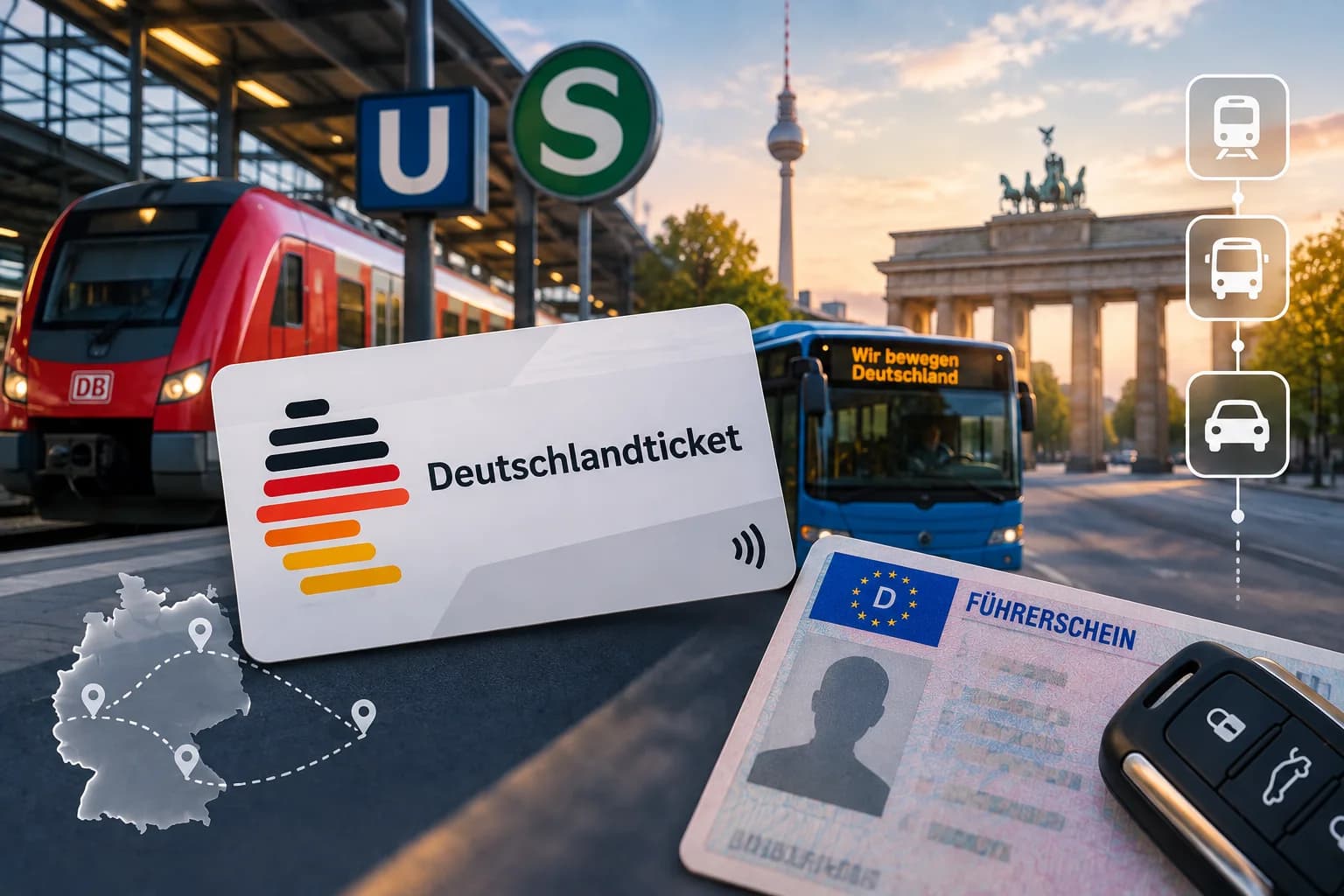
Public Transportation, Deutschlandticket & Driving License Conversion in Germany

·
9 min read
·
AI

How to navigate local and long-distance trains, purchase regional passes, convert your foreign driver's license, and understand car leasing or purchasing.

Public Transportation, Deutschlandticket & Driving License Conversion in Germany

Public Transportation, Deutschlandticket & Driving License Conversion in Germany

Navigating a new country requires understanding its transit networks and transport regulations. Germany offers a highly integrated public transportation system alongside structured processes for converting foreign driving licenses.

This guide outlines how the German transit network operates, how to utilize the nationwide Deutschlandticket, the steps required to convert a foreign driving license, and the basics of acquiring a vehicle through leasing or purchasing.


Understanding the German Public Transportation Network

Germany’s public transit network is divided into two primary categories: local/regional transport (Nahverkehr) and long-distance transport (Fernverkehr). Local transit is managed by regional transport associations (Verkehrsverbünde), meaning a single ticket often covers buses, trams, and local trains within a specific metropolitan area or region.

Local and Regional Transit (Nahverkehr)

Within cities and neighboring districts, commuters typically use a combination of four transport modes:

  • U-Bahn (Untergrundbahn): Subway or underground trains operating primarily in large major cities.
  • S-Bahn (Stadtschnellbahn): Suburban rapid transit trains that connect city centers with outlying suburbs and nearby towns.
  • Straßenbahn / Tram: Streetcars or light rail networks, common in both large and mid-sized cities.
  • Buses: Regional and city bus routes that fill the gaps between rail networks.
  • Regionalbahn (RB) and Regional-Express (RE): Regional trains connecting towns and cities. The RE stops only at major stations, while the RB stops more frequently.

Long-Distance Transit (Fernverkehr)

For travel between major German and European cities, high-speed rail and long-distance coaches are the standard:

  • Intercity Express (ICE): High-speed electric trains reaching speeds up to 300 km/h, connecting major metropolitan hubs.
  • Intercity (IC) and Eurocity (EC): Standard long-distance trains. Eurocity routes cross international borders.
  • Private Operators: Companies like FlixBus and FlixTrain offer budget-friendly long-distance road and rail travel.

The Deutschlandticket (D-Ticket)

The Deutschlandticket is a nationwide subscription ticket designed to simplify regional transit. It replaces the need to navigate regional ticketing tariffs for local travel.


Feature Details
Price €58 per month (subject to periodic adjustments by transit authorities)
Validity Calendar month subscription; automatically renews
Format Digital (smartphone app) or chip card; paper options are generally phased out
Usage Scope All local and regional transit nationwide (RE, RB, S-Bahn, U-Bahn, Tram, Bus)
Exclusions Long-distance trains (ICE, IC, EC), FlixTrain, and long-distance buses

Key Eligibility and Purchase Rules

  • Subscription Model: The Deutschlandticket is sold as an ongoing monthly subscription. It is not designed as a single-use tourist ticket, though short-term visitors can use it if they manage the subscription cancellation window.
  • Cancellation Deadline: To avoid being charged for the subsequent month, cancellation must typically be submitted by the 10th day of the current month. If cancelled after the 10th, the subscription will continue and must be paid for through the end of the following month.
  • Personal and Non-Transferable: The ticket is registered to a specific name and requires matching photo identification (such as a passport or residence card) during ticket checks.
  • Purchasing Channels: Available via the Deutsche Bahn (DB) website or app, regional transport authority apps (such as BVG in Berlin, MVV in Munich, or RMV in Frankfurt), and local transit service centers.

Driving License Conversion (Führerscheinumschreibung)

Expats moving to Germany who plan to drive must understand the rules regarding foreign driving licenses. Operating a vehicle with an invalid license can result in serious legal consequences, including fines and loss of insurance coverage.

The Six-Month Rule

If your driving license was issued by a non-EU/EEA country, it is generally valid for six months from the date you register your address (Anmeldung) in Germany.

  • During this six-month window, you must carry your original license.
  • Depending on the issuing country, an International Driving Permit (IDP) or an official German translation of your license may also be required.
  • If you plan to reside in Germany for less than 12 months, you can apply for a six-month extension of your foreign license validity at your local driver licensing office (Fahrerlaubnisbehörde). This must be requested before the initial six months expire.
  • Once the six-month period ends, you are no longer legally permitted to drive on German roads using your foreign license unless it has been converted.

EU and EEA Licenses

If your license was issued by an EU or EEA member state, it remains valid in Germany until its natural expiration date. Conversion is voluntary in most cases, provided the license is still valid and not a temporary or provisional license.

Non-EU/EEA Conversion Pathways

For citizens of non-EU/EEA nations, the conversion process (Umschreibung) depends on bilateral reciprocity agreements between Germany and the country that issued the license. These agreements are detailed in Annex 11 (Anlage 11) of the German Driver’s License Regulation (Fahrerlaubnis-Verordnung).

[Is your license from an EU/EEA country?]
   ├── Yes ──> Valid until expiry (No immediate conversion required)
   └── No  ──> [Check Annex 11 / Reciprocity List]
                 ├── Full Reciprocity ────> Convert without exams
                 ├── Partial Reciprocity ─> Convert with theory OR practical exam only
                 └── No Reciprocity ──────> Convert with both theory AND practical exams
  • Full Reciprocity (e.g., Canada, Japan, South Korea, select US states): Drivers can convert their license directly without taking a German written (theory) or practical driving test.
  • Partial Reciprocity (e.g., select US states): Drivers may be required to take either the theory test or the practical driving test, but not both.
  • No Reciprocity (e.g., India, Turkey, select US states, many non-EU nations): Drivers must register with a driving school (Fahrschule), pass the theoretical exam, and pass the practical driving test. However, they are usually exempt from the mandatory minimum number of driving hours required for first-time learners, which reduces overall costs.

Step-by-Step Conversion Procedure

Step 1: Gather Required Documents

The following documents are typically required when applying for conversion at the local licensing office (Fahrerlaubnisbehörde or Bürgeramt):

  • Valid Passport / ID Card along with your current residence permit (Aufenthaltstitel).
  • Proof of Registration: Your address registration certificate (Meldebescheinigung).
  • Original Foreign Driving License: It must still be valid at the time of application.
  • Certified German Translation: Often required if the license is not in German or English. The ADAC (German Automobile Club) or sworn translators provide this service.
  • Biometric Passport Photo: Must meet current German government specifications.
  • Eye Test (Sehtest): Conducted by an optician or ophthalmologist within the last two years.
  • First Aid Course Certificate (Erste-Hilfe-Kurs): Evidence of completing a basic first aid training course.
  • Confirmation of Driving History: In some cases, a certificate or record from the issuing authority proving how long you have held the license is required, especially if the issue date on the card is recent due to a renewal.

Step 2: Book an Appointment and Submit the Application

Schedule an appointment with the local licensing authority. Bring all original documents and photocopies. You will be required to pay an administrative fee, which typically ranges from €35 to €50 (excluding translation, eye tests, first aid courses, and driving school fees).

Step 3: Register with a Driving School (If Exams Are Required)

If you must sit the exams:

  • Sign up with a local driving school (Fahrschule). They will register you for the exams once the licensing authority approves your application.
  • The theory exam can be taken in several languages, including English, French, Spanish, Russian, Arabic, and Turkish.
  • The practical exam is conducted with an examiner in the vehicle, and instructions are given in German.

Step 4: Collect Your German License

Once your application is approved and any necessary exams are passed, you can collect your German driving license (Führerschein). In most jurisdictions, you must surrender your original foreign license in exchange for the German one.


Car Ownership, Purchasing, and Leasing

While public transport covers most daily needs, some expats choose to purchase or lease a car.

Buying a Car (Neu- oder Gebrauchtwagen)

  • New Cars (Neuwagen): Can be purchased directly from dealerships. Dealerships often handle the initial vehicle registration (Zulassung) on your behalf.
  • Used Cars (Gebrauchtwagen): Available through dealerships or private sellers. When buying privately, ensure you receive both parts of the registration certificate: Zulassungsbescheinigung Teil I (vehicle registration document) and Zulassungsbescheinigung Teil II (ownership certificate).
  • Mandatory Insurance: You cannot register a vehicle or drive on German public roads without third-party liability insurance (Kfz-Haftpflichtversicherung). Upon purchasing insurance, you will receive an electronic confirmation number (eVB-Nummer) required for registration.

Leasing a Car

Leasing is a common alternative to purchasing. It allows you to drive a vehicle for a set period (usually 24 to 48 months) with fixed monthly payments.

  • Credit Check (Schufa): Leasing companies require a good German credit score (Schufa). Newly arrived expats without a credit history in Germany may face difficulties securing a lease agreement or may be asked to provide a higher deposit or a guarantor.
  • Residence Permit Requirements: Leasing companies often require that your German residence permit is valid for at least the entire duration of the lease contract.
  • Maintenance and Insurance: Review whether maintenance, repairs, and comprehensive insurance (Vollkasko) are included in the monthly lease rate or if they must be arranged and paid for separately.

Common Mistakes and Practical Tips

  • Validating Tickets: In many German cities (such as Berlin and Munich), purchasing a physical paper ticket is not enough. You must validate it by stamping it in the small machines on the platform or inside the tram/bus before starting your journey. Riding with an unstamped ticket carries the same fine as riding without a ticket.
  • The 10th-Day Cancellation Rule: If you only need the Deutschlandticket for one specific month, you must cancel the subscription by the 10th day of that month. Otherwise, you will automatically be billed for the next month.
  • Delaying License Conversion: Do not wait until the end of your first six months in Germany to start the conversion process. Gathering documents, securing appointments, and waiting for the authority’s approval can take several months. If your six-month eligibility window closes before you receive your German license, you will not be allowed to drive.
  • Driving School Selection: If you need to take driving exams, look for a Fahrschule with experience in license conversions (Umschreibung). Some schools specialize in expedited tracks for experienced foreign drivers and have instructors who can explain maneuvers in English.

STAY CONNECTED WITH THE EXPAT COMMUNITY

Subscribe to get expat tips, local insights, and connect with professionals around the world.